IB Biology C1.2 Notes
This page contains our IB Biology notes for C1.2. By reading each one of these notes, you will fully cover the content for IB Biology 'Respiration'.
Respiration and ATP
When considering cells and metabolism throughout IB biology, you need to understand that the energy required for all processes needs to come from somewhere. It always appears in the form of adenosine triphosphate (ATP).
ATP is a nucleotide and is the universal energy currency of the cell. In animals it is synthesised in the mitochondria via oxidative phosphorylation. It is often likened to a rechargeable battery as when a cell requires energy, ATP splits off one of its 3 phosphates via hydrolysis to become ADP (adenosine diphosphate) releasing energy in the process. ADP is then ‘recharged’ with an inorganic phosphate ion back to ATP as and when required. This is what is meant by the ATP-ADP cycle.
The hydrolysis of ATP into ADP releases free energy as it is an exergonic process; in animals up to 60% of this is lost as heat – rather than all of it fuelling the actual chemical reactions taking place.
However, for ATP to be used in cellular processes, it needs to be generated from ADP and phosphate. This is done by cell respiration, defined as how a cell produces its own ATP from organic compounds. As a result, ATP is immediately usable as an energy source anywhere in the cell for any process.
During this, the organic compounds used are primarily carbohydrates (particularly glucose), followed in order of preference by lipids and proteins.
Do note that cell respiration is different than gas exchange. Gas exchange refers to the exchange of oxygen and carbon dioxide during ventilation in the respiratory system of animals, whilst respiration refers to the continuous generation of ATP.
There are two types of cell respiration:
- Aerobic respiration - respiration that uses oxygen. This occurs in the cytoplasm and mitochondria.
- Anaerobic respiration - respiration that does not use oxygen. This only occurs in the cytoplasm and does not require mitochondria.
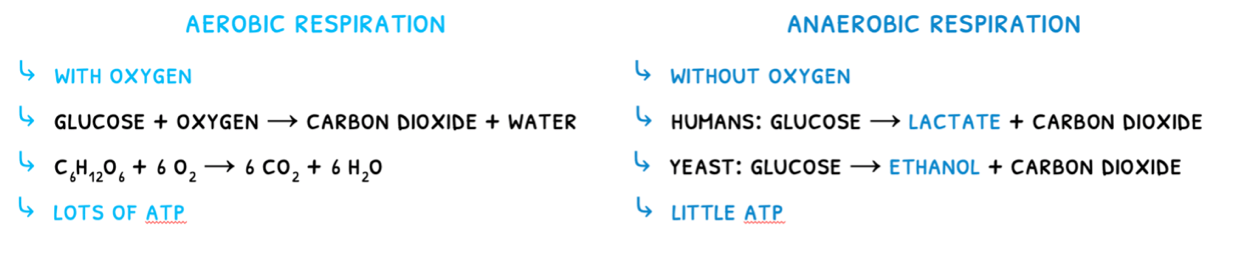
The type of respiration used in dependent on the situation. Although anaerobic respiration does not provide a lot of ATP, it is very rapid and maximizes the power of muscle contractions. It is thus used in muscles carrying out vigorous exercise such as sprinting or lifting.
HL students need to learn the process of respiration in more detail.
tibertutor.com
Next Up
You have completed the sub-topic C1.2 notes, covering "Respiration" for IB Biology - continue with related resources below or explore the full IB Biology course from the IBO.
Other Sub-topic C1.2 resources