IB Physics Topic 2 Notes
This page contains our IB Physics notes for topic 2. By reading each one of these notes, you will fully cover the content for IB Physics 'The Particulate Nature of Matter'.
Chapters
Phases of matter
In Topic A.3, considerable time was taken in expanding on the types of energy you will encounter during IB physics. However, when considering the behavior of energy and how it transfers between objects, you need to understand how the particles within objects behave to store and release energy.
To begin, remember that each object can present itself as a state of matter (solid, liquid or gas) but can switch between them. The kinetic theory governs the properties of each phase: solids, liquids, and gases.
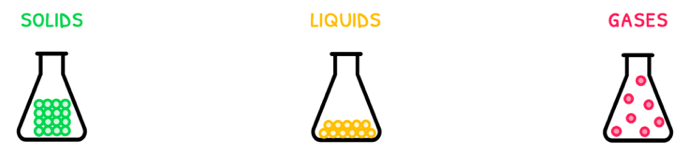
- Solids have a fixed volume and shape because their particles vibrates around a fixed position held there by strong intermolecular forces. This is typically the densest phase.
- Liquids have a fixed volume and fill the shape of their container, because their particles slide over one another due to weaker intermolecular force. This phase typically has an intermediate density.
- Gases do not have a fixed volume and fill the shape of thier container, because their particles move randomly in space due to their very weak intermolecular forces. This phase typically has the lowest density.
Note that density is the ratio of mass to volume. The formula for this is:
tibertutor.com
Next Up
You have completed the topic 2 notes for IB Physics - continue with related resources below or explore the full IB Physics course from the IBO.
Other topic 2 resources