Aligning lessons with the 2026 IB syllabus: a teacher's guide
Start today by downloading two documents: the subject brief and the full subject guide for whichever course you teach, both available from the IB curriculum updates page. Pick one unit to rework first, map its objectives against the new learning outcomes, and choose the planner level that matches how much detail your department needs on file. That is how to align lessons to the IB syllabus 2026 without losing a term to admin.
Do these three things before you plan anything else:
- Download the subject brief and subject guide for your course from IBO.org.
- Choose a single pilot unit rather than trying to rewrite everything at once.
- Check the first teaching and first assessment dates for your subject so you know your real deadline.
Some subjects move to the new syllabus for first teaching in 2026, others in 2027, so confirm your subject’s window before you commit hours to a full rewrite.
Key Takeaways
Aligning lessons to the 2026 IB syllabus works because it starts with the subject brief, converts outcomes into command-term objectives, and checks coverage before assessment, not after.
| Point | Details |
|---|---|
| Start with one pilot unit | Download the subject brief and guide, then rework a single unit before scaling the approach. |
| Use command terms precisely | Convert each syllabus outcome into an objective using the exact command term from the guide. |
| Match planner detail to purpose | Use Planner 2 for standard units and Planner 3 for the department’s model exemplar. |
| Sequence practicals deliberately | Stagger independent experimental design across several lessons to show IA-relevant progression. |
| Check coverage before assessing | Run a full unit coverage check against DP criteria before finalising summative tasks. |
Table of Contents
- How do you align lessons with the IB syllabus for 2026?
- Mapping objectives to command terms and criteria
- Designing assessments that actually prove alignment
- Choosing the right DP unit planner for your subject
- What changes for IB science practicals and labs
- When should you finish aligning each unit?
- How Tiber Tutor supports your alignment work
- Get exam-ready assessments without building them from scratch
- Where to check the official guidance
- What actually matters when rewriting for 2026
- Sources
- FAQ
How do you align lessons with the IB syllabus for 2026?
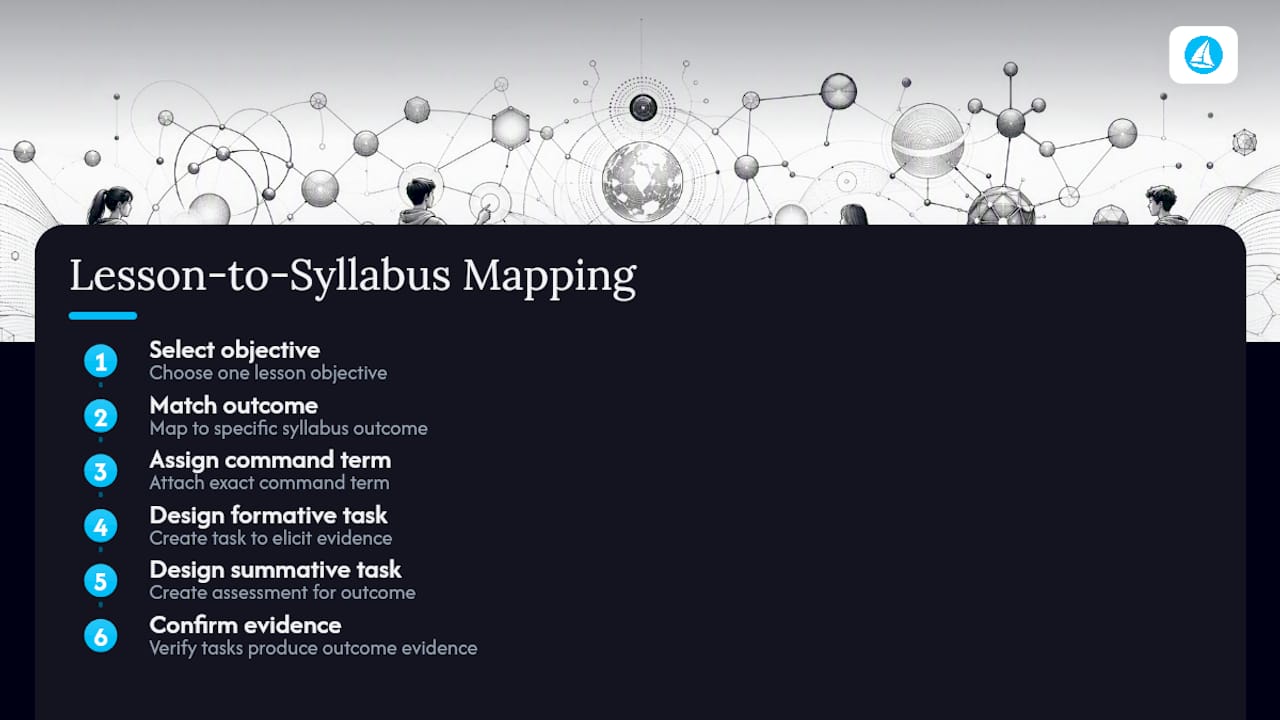
Reworking a unit is a sequence, not a scramble. Treat it as five steps, done in order, and you avoid the trap of redesigning activities before you know what they need to prove.
- Extract the outcomes. Read the subject brief and subject guide line by line and pull out every updated learning outcome and command term for your topic.
- Rewrite the objectives. Turn each outcome into a lesson objective that uses the actual command term, not a softened version of it. “Describe” and “evaluate” demand different evidence.
- Design the activity and formative check. Build a task and a quick formative measure that generates real evidence the objective was met, not just that the lesson happened.
- Build or adapt the summative task. Write or revise the assessment, then note explicitly which DP criteria it addresses.
- Run a coverage check. Go back across the whole unit and confirm every required DP criterion appears somewhere, with evidence attached.
Pro Tip: Keep a single tracking sheet across the whole unit rather than checking coverage lesson by lesson. It’s far easier to spot a missing criterion when you can see the whole sequence on one page.
The temptation is to jump straight to step three, because activities are the fun part. Resist it. Rebuilding lessons in this order took teachers days rather than weeks, because there’s no going back to patch objectives once the activities are already written.
Mapping objectives to command terms and criteria
Command terms are the verbs the IB uses to signal the depth of thinking an assessment expects, from “state” and “identify” at the lower end to “discuss” and “evaluate” at the top. Converting a syllabus outcome into a usable lesson objective means picking the term the subject guide actually uses for that outcome, not a synonym you find easier to teach.
Use a compact five-part chain for every lesson:
- Syllabus outcome → objective written with the correct command term → activity → formative evidence → summative link.
Recording this as one alignment column in your lesson plan, rather than scattering it across notes, makes the mapping visible at a glance during moderation. The DP curriculum alignment studies show subject reports for physics, mathematics, chemistry and biology comparing content demand against national systems, which is worth checking if you’re unsure how deep an outcome needs to go. Tiber Tutor’s IB assessment criteria guide breaks down exactly this kind of criteria mapping for teachers building their own tracking sheets.
Designing assessments that actually prove alignment
An assessment only counts as aligned if it is valid, consistent with what you taught, transparent to students beforehand, and fair across different student groups. Miss any one of those and moderators, and students, will notice.
- Map each formative check directly to a criterion, then use it as a rehearsal for the summative task that follows.
- Vary formative formats: short written responses, verbal questioning, peer marking against a rubric, so students meet the assessment language before it counts.
- For sciences, document how each internal assessment task links to the practical skills built earlier in the unit, particularly under the current IA criteria.
- Never assess a command term you haven’t given students structured practice using.
Tiber Tutor’s IB exam guide for science students is a useful reference here, since examiner-written exam-style questions show you the actual phrasing and depth an assessment needs to hit a given criterion.
Choosing the right DP unit planner for your subject
The IB offers three planner templates, and picking the wrong one wastes time either way. Planner 1 suits a low-detail overview, good for a quick sketch of a short unit. Planner 2 adds medium detail and works well for most standard-length units. Planner 3 is the high-detail version, best reserved for pilot units you’ll use as a department-wide model.
- Start with Planner 2 unless your unit is very short or you’re building the department’s first fully documented exemplar.
- Populate the transfer goals and essential understandings first. The IB’s planning guidance treats these as compulsory fields, not optional extras.
- Write the inquiry question, then work through inquiry, action and reflection in that order for each lesson sequence.
Pro Tip: If you’re reworking titration or equilibrium lessons, write the inquiry question before the practical, not after. Students investigate more purposefully when the question comes first.
What changes for IB science practicals and labs
Science teachers face a specific problem: practical skills need explicit sequencing, not just paper-based objectives. Map every lab session to a stated objective and, where relevant, to an IA criterion, so the skill progression is visible across the term rather than buried in individual lesson plans.
- Sequence practical technique from guided to independent design across several lessons, not a single unit.
- Note safety and resourcing requirements directly in the unit planner so moderators see preparation was intentional.
- Stagger opportunities for independent experimental design across multiple lessons, which lets students show methodological progression that maps to IA expectations, according to the DP alignment studies.
- Watch for the common trap of over-teaching paper skills while under-practising bench technique. Fix it by scheduling at least one hands-on session per fortnight, even during theory-heavy topics.
Tiber Tutor’s science lesson planning guide and chemistry syllabus breakdown both work through this sequencing problem subject by subject.
When should you finish aligning each unit?
Front-load the highest-priority tasks and spread the rest across the year rather than trying to rewrite the whole course over a summer.
- In the first fortnight: download the subject brief and guide, and pick your pilot unit.
- By the end of the first month: complete the full mapping for that pilot unit and get a colleague to peer review it.
- By the end of term one: run the unit, collect student evidence, and adjust the mapping based on what actually happened in the classroom.
- Across the rest of the year: repeat the process unit by unit, storing an alignment grid, samples of student evidence, and assessment rubrics in each unit folder for moderators.
A ready-made template can shortcut the formatting, though any tool’s output still needs your professional judgement to check the concepts and inquiry quality are right, not just the layout. Ready-made templates like these lesson plan resources can help with formatting while you focus on the content decisions.
How Tiber Tutor supports your alignment work
Tiber Tutor gives IB science and maths teachers a way to check coverage against the new syllabus without building every practice question from scratch. Every resource is written by IB examiners and experienced educators, so the phrasing and depth already reflect what real exams demand, not a generic approximation of them.
- Syllabus monitoring that flags which topics and command terms a class has actually covered.
- Exam-style questions, topic tests, and full mock exams built to mirror current IB marking standards.
- Animated instructional videos that reinforce difficult concepts once the lesson itself is delivered.
- Progress analytics that show exactly where a class is weak, well before a mock exam confirms it.
Export a Tiber Tutor topic test straight into your unit planner as the summative task, and your coverage-to-assessment link is already documented.
Get exam-ready assessments without building them from scratch
Rewriting lesson objectives is only half the job. The other half is finding assessments that genuinely test those objectives at the right command-term depth, and that’s where most teachers lose time. Tiber Tutor’s IB Biology exam-style tests and IB Chemistry exam-style tests are built by IB examiners, which means the questions already sit at the correct command-term depth for each objective you map.
Pair these with the IB Chemistry mock exams or IB Biology mock exams when you need a full summative task ready to slot into your unit planner rather than drafted from a blank page. No competing IB resource offers this depth of examiner-written content combined with syllabus monitoring and analytics in one interlinked platform, and for the price of a single subscription, that combination is difficult to match anywhere else.
Where to check the official guidance
- IB curriculum updates
- DP unit planners and planning guidance
- DP curriculum alignment studies
- Concept-based teaching and learning report
What actually matters when rewriting for 2026
Most advice on syllabus alignment focuses on paperwork: filling in the right planner boxes and ticking off criteria. That’s necessary, but it misses the harder problem, which is that concept-based teaching only works if teachers get proper support translating principles into daily lessons. The IB’s own concept-based teaching and learning report found a real gap between what curriculum documents describe and what happens in classrooms, and no amount of tidy mapping columns closes that gap on its own.

My honest view: teachers over-invest in getting the planner format perfect and under-invest in checking whether their formative tasks generate real evidence, not just busy work. A beautifully completed Planner 3 with weak formative checks will still fail moderation. Prioritise the evidence chain first, the paperwork second.
For sciences and maths specifically, the biggest risk isn’t misunderstanding the new outcomes. It’s sequencing practical or problem-solving skills too late, after the theory is already locked in. Build practical progression from week one, not as a bolt-on once the syllabus content is “done.”
Sources
- Read curriculum updates
- DP unit planners and planning guidance
- DP curriculum alignment studies (2023–2025)
- Concept-based teaching and learning: integration and alignment across IB programmes
FAQ
How do you ensure your lessons align with the curriculum?
Map each lesson objective to a specific syllabus outcome and command term, then confirm your formative and summative tasks generate evidence against that exact outcome before moving on.
Did the IB syllabus change recently?
Yes. Several DP subjects move to revised subject guides with new first teaching and first assessment dates, and the exact timeline varies by subject, so checking your subject’s brief on IBO.org is essential.
How do you vertically align a curriculum?
Vertical alignment means sequencing skills and concepts progressively across years so later lessons build directly on earlier ones. For IB sciences, this typically means staging practical technique from guided tasks toward independent experimental design across the course.

Is there a PDF version of the IB Biology syllabus for 2026?
The IB publishes the official subject brief and subject guide as downloadable documents through IBO.org rather than a single generic PDF, and access depends on your school’s IB account permissions.