How to structure an IB homeschool year: a two-year roadmap
The reliable way to structure an IB homeschool year is a two-year, school-affiliated plan that timetables Theory of Knowledge (TOK), the Extended Essay (EE) and Creativity, Activity, Service (CAS) as scheduled subjects, not afterthoughts, and secures Internal Assessment (IA) supervision through an authorised IB World School from day one. Skip either piece and the plan stalls, usually in the final term when IAs are due and nobody with IB authorisation has signed off on them.
Here’s the verdict in short:
- You must be registered at an IB World School or an authorised partner provider; the Diploma Programme cannot be completed as a fully independent private candidate because IAs need supervision and marking by registered IB teachers.
- Treat the core (TOK, EE, CAS) as timetabled subjects with their own weekly slots, not weekend catch-up work.
- Plan Higher Level (HL) and Standard Level (SL) study hours across two full years, not one compressed one.
Three things to do this week: contact two or three IB World Schools about part-time or satellite enrolment, draft a master calendar with the Diploma Programme’s two-year span mapped onto it, and block out weekly study hours per subject before term starts. The IBO sets the rules; a resource like Tiber Tutor helps you meet them for the sciences and maths.
Key Takeaways
A two-year, school-affiliated plan that timetables TOK, EE and CAS alongside HL and SL subject hours is the only structure that reliably gets an IB homeschool student to exam day prepared.
| Point | Details |
|---|---|
| Secure enrolment early | Contact IB World Schools about part-time or satellite enrolment before building your study calendar. |
| Timetable the core | Schedule TOK, EE and CAS as fixed weekly subjects, not final-year catch-up work. |
| Follow the hour guidance | Plan roughly 240 hours per HL subject and 150 hours per SL subject across two years. |
| Run mocks with purpose | Sit full mocks two to three months before finals and convert results into targeted revision. |
| Use exam-aligned STEM practice | Tiber Tutor’s examiner-authored questions, IA exemplars and progress dashboards keep Biology, Chemistry, Physics and Maths on track between supervisor check-ins. |
Table of Contents
- What does a 24-month IB homeschool roadmap look like?
- What are the hard DP rules a homeschool plan can’t skip?
- How do you enrol in the IB while homeschooling?
- What term-by-term milestones keep an IB homeschool year on track?
- What does a sample weekly IB homeschool schedule look like?
- How should you schedule TOK, the EE and CAS?
- How do you manage IAs, mocks and final exam prep?
- Which resources actually help you plan and teach the science subjects?
- What mistakes derail an IB homeschool plan, and how do you fix them?
- What actually works when families run the DP from home?
- How can Tiber Tutor support your family’s IB homeschool year?
- Sources
- FAQ
What does a 24-month IB homeschool roadmap look like?
Cramming two years of Diploma Programme content into eighteen months is the single most common reason families burn out by February of the final year. A phased 24-month structure spreads the load and builds in recovery time before exams, rather than treating mocks as the first moment anyone notices a gap.
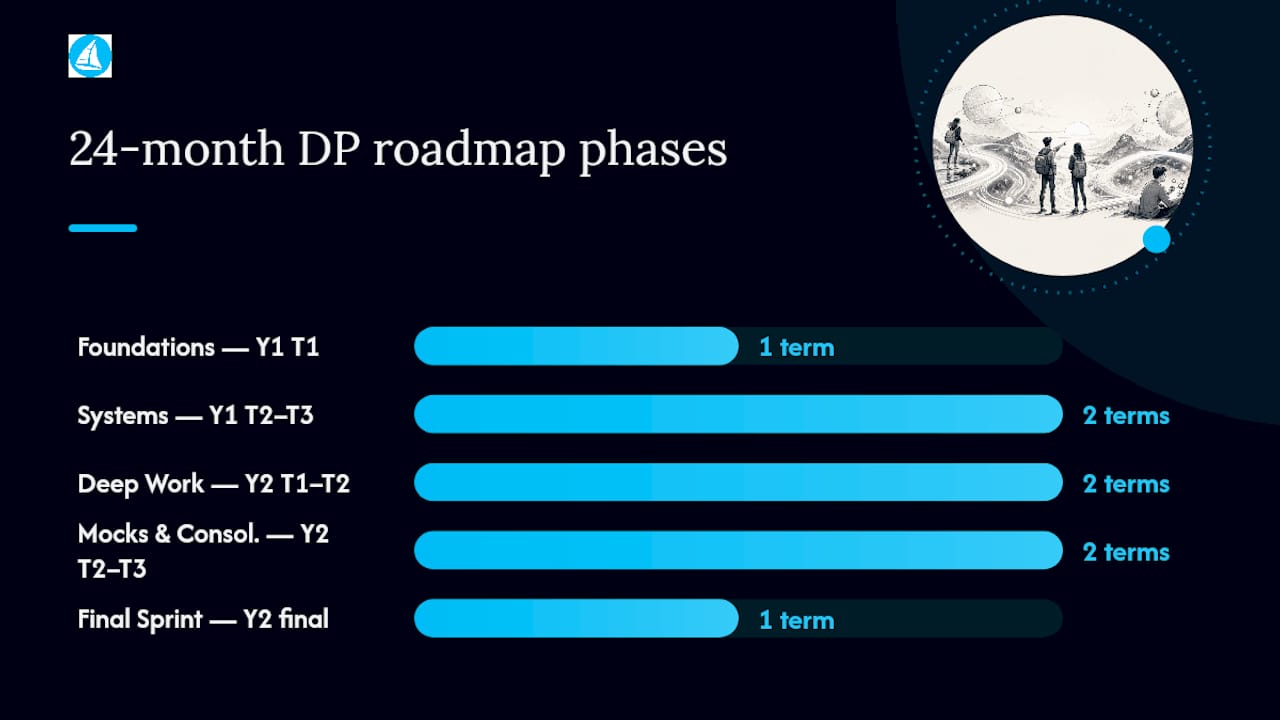
A workable version breaks into five phases, echoing the staged approach recommended in Sparkl’s 24-month DP roadmap:
- Foundations (Year 1, Term 1): map the syllabus for every subject, start EE topic exploration, open a CAS log, begin light IA scaffolding.
- Systems (Year 1, Terms 2 to 3): build consistent weekly routines, start first IA drafts, keep TOK reflections running weekly.
- Deep Work (Year 2, Terms 1 to 2): finish IAs, complete the EE draft, push through the densest syllabus content.
- Mocks & Consolidation (Year 2, Term 2 to 3): full mock exams across all subjects, convert results into targeted revision.
- Final Sprint (Year 2, final term): past papers, timed practice, exam technique refinement.
Year 1 priorities sit firmly on groundwork: syllabus mapping, an EE topic that survives scrutiny, and CAS activities that start early enough to show sustained commitment. Year 2 shifts towards completion and rehearsal, with IAs and the EE finished well before the final term so revision time isn’t competing with coursework deadlines.
| Phase | Focus | Typical timing |
|---|---|---|
| Foundations | Syllabus mapping, EE topic, CAS start | Year 1, Term 1 |
| Systems | Weekly routines, first IA drafts | Year 1, Terms 2 to 3 |
| Deep Work | IA and EE completion, dense content | Year 2, Terms 1 to 2 |
| Mocks & Consolidation | Full mocks, targeted revision | Year 2, Term 2 to 3 |
| Final Sprint | Past papers, exam technique | Year 2, final term |
This pacing also has to bend around exam session timing. Most Diploma students sit final exams in May, with a smaller November session available in some regions, so mocks typically land two to three months before whichever session your student is registered for.
What are the hard DP rules a homeschool plan can’t skip?
The Diploma Programme requires six subject groups plus the core, and the IBO sets that structure regardless of whether the student attends a physical classroom or studies from a kitchen table. Interdisciplinary or dual-purpose subject choices can sometimes satisfy more than one group requirement, but the six-group framework itself doesn’t flex.
Teaching hours matter more than most homeschool planners realise. HL subjects carry roughly 240 teaching hours across the two years; SL subjects sit around 150 hours. That’s not classroom-only time. It represents the depth of content coverage the IB expects, and it translates directly into weekly study hours once you divide it across 24 months.
Hour reality check: three HL subjects at roughly 240 hours each plus three SL subjects at roughly 150 hours each adds up to well over 1,100 hours of subject content across two years, before the core is even counted.
The core itself isn’t optional extra reading. TOK, the EE and CAS are required programme components that carry their own assessment weight and their own deadlines. A homeschool plan that treats them as “whenever there’s time” work is the single most common reason strong students fall behind in the final term.
- Six subject groups: three at HL, three at SL is the typical distribution, though some students take more HL subjects.
- HL teaching hours per subject are roughly twice as many as SL teaching hours, reflecting greater depth of content coverage.
- TOK, EE and CAS are compulsory, assessed or evidenced, and need their own timetable slots.
- Interdisciplinary subject options can sometimes cover more than one group requirement, but check with your school first.
How do you enrol in the IB while homeschooling?
This is the part most homeschool guides gloss over, and it’s the part that actually determines whether the diploma gets awarded. Internal assessments must be supervised and marked by registered IB teachers working within an authorised IB World School. There’s no clean private-candidate route around this for the full Diploma, because the IB’s assessment model depends on institutional affiliation, not an external-exam board sitting outside any school.
That means “homeschooling IB” in practice usually means a hybrid: independent study at home, paired with a formal relationship to a school that can supervise IAs, run mocks, and submit coursework on the student’s behalf. Some families arrange part-time or satellite enrolment; others access partner-delivered online courses through providers that themselves operate via school partnerships, though exact fees and responsibilities vary by school and region.
Work through enrolment in this order:
- Shortlist schools already authorised to deliver the DP, including any offering part-time or online-supported pathways.
- Email the DP coordinator, not general admissions, and ask specifically about satellite or partial enrolment for homeschooled students.
- Request documentation covering IA supervision responsibilities, mock exam access, and fee structure in writing before committing.
- Confirm subject availability, since not every partner school offers every HL/SL combination in the sciences and maths.
- Get the agreement in writing, including who signs off on IAs and when mock papers are scheduled.
Pro Tip: Ask the DP coordinator directly, “who will supervise and sign off my child’s IAs, and when are the mock exam windows?” That single question filters out schools that aren’t set up for homeschool partnerships before you invest weeks in the wrong conversation.
What term-by-term milestones keep an IB homeschool year on track?
A calendar with only “exams in May” on it is not a plan. Break the two years into terms with specific submission and check-in points, and the whole thing becomes far less daunting because no single week carries the entire weight of the diploma.
The table below reflects a typical pacing built around a May exam session, adapted from the phase structure in Sparkl’s roadmap:
| Term | Milestone | Action |
|---|---|---|
| Year 1, Term 1 | EE topic proposal | Draft and discuss with a supervisor |
| Year 1, Term 2 | First TOK reflections | Weekly short written links to subject content |
| Year 1, Term 3 | Early IA drafts | Submit for informal supervisor feedback |
| Year 2, Term 1 | IA near-final drafts | Formal supervisor review and sign-off cycle begins |
| Year 2, Term 1 | CAS evidence checkpoint | Log activities and reflections to date |
| Year 2, Term 2 | EE final draft | Submit ahead of official deadline |
| Year 2, Term 2 | Mock exams (full set) | Sit under timed exam conditions |
| Year 2, Term 3 | Final IA submissions | Confirm supervisor sign-off and receipt |
| Year 2, Term 3 | Final revision sprint | Past papers and timed rehearsals |
If your student started late, or one subject is proving heavier than expected, don’t try to compress everything evenly. Shift the Deep Work phase later for that specific subject and pull mocks slightly closer to exams so the revision window doesn’t shrink too much elsewhere.
- Copy the milestone table into a shared family calendar, colour-coded by subject or core component.
- Mark exam session cut-off dates first, then work backwards to place IA and EE deadlines with buffer weeks.
- Schedule a short review conversation after every milestone, not just after mocks.
What does a sample weekly IB homeschool schedule look like?
A student carrying three HL and three SL subjects, plus the full core, needs a weekly structure that doesn’t collapse the moment one subject demands extra attention. Based on time budgets used in practical two-year DP guides, HL subjects typically need 9 to 14 hours a week early in the programme, while SL subjects sit closer to 6 to 10 hours a week, rising as deadlines approach.
| Component | Weekly hours (Year 1) | Weekly hours (Year 2) |
|---|---|---|
| HL subject (each) | 9 to 14 hours | 9 to 14 hours |
| SL subject (each) | 6 to 10 hours | 6 to 10 hours |
| TOK | 2 to 3 hours | 2 to 3 hours |
| Extended Essay | 2 to 4 hours | 1 to 3 hours (post-submission: revision) |
| CAS | 2 to 4 hours | 2 to 3 hours |
Weekly study time in Year 1 can be substantial when considering all subjects and core components, then tapers slightly as the Extended Essay work finishes and focus shifts towards exam practice.
A single weekday might run like this:
- Morning block (2 hours): one HL subject, focused study or problem sets.
- Second block (90 minutes): SL subject or IA writing time.
- TOK slot (30 to 45 minutes): short reflection connecting the week’s subject content to a TOK concept.
- Afternoon block (2 hours): second HL or SL subject, alternating daily.
- CAS time (variable): built around the activity itself, logged the same day.
Weekends work better as consolidation and mock practice than new content. Alternate intensive study days with lighter review days, and build in at least one genuine rest day per week; a student running at full intensity for six days straight tends to lose accuracy on the seventh anyway. As mock season approaches, swap one weekday afternoon block for full-length timed papers using a resource like Tiber Tutor’s structured study schedule guidance for IB science pacing.
How should you schedule TOK, the EE and CAS?
Independent students consistently underestimate the core, and practitioners working with homeschool families report it’s the single most common failure point, not the six subjects themselves. The fix is treating TOK, EE and CAS exactly like timetabled subjects with their own recurring slots.
Break the EE into stages with micro-deadlines: topic decision, literature review, research method, first draft, supervisor feedback, final submission. Keep a simple decision log recording why a topic or method was chosen and what was rejected along the way; it makes the required reflections far easier to write later and removes the panic of trying to reconstruct reasoning months after the fact.
TOK works best as a weekly habit rather than a termly cram. A fifteen-minute Friday reflection linking that week’s Biology or Physics content to a TOK question keeps the material fresh for the eventual presentation and essay, rather than trying to invent connections retroactively.
CAS needs the lightest touch but the most consistency: regular activities logged with short reflections as they happen, checked against your school’s specific learning outcome expectations.
- Break the EE into decision log, literature review, method, draft and final submission stages.
- Run a fifteen-minute weekly TOK reflection tied to current subject content.
- Log CAS evidence the same week the activity happens, not months later.
- Schedule supervisor meetings on a fixed cadence, not “whenever there’s time.”
Pro Tip: Keep every piece of core evidence, TOK notes, EE drafts, CAS logs, in one shared folder your supervisor can access. When submission time arrives, nobody is hunting for a reflection written eight months earlier.
How do you manage IAs, mocks and final exam prep?
IA supervision isn’t a signature at the end. It needs a feedback cycle: draft submitted, supervisor comments returned, revisions made, formal sign-off recorded, and a submission receipt kept on file. Parents don’t need to mark the work themselves, but they do need to confirm each step actually happened on schedule.
Mock exams work best run as full, timed papers roughly two to three months before the real exam session, marked against official criteria where possible, with results immediately converted into a short list of focused revision tasks rather than a vague sense of “needs more work.”
- Confirm supervisor sign-off dates for each IA and log them against your master calendar.
- Schedule full mock exams for every subject two to three months before the final session.
- Convert mock results into a written list of three to five specific revision priorities per subject.
- Run timed past-paper practice weekly in the final term, watching for the exact phrasing examiners use in mark schemes.
- Build in stress-management routines, short breaks, sleep, physical activity, especially in the final sprint.
- Keep IA draft feedback, supervisor comments and submission receipts in one dated folder.
- Treat mock results as data, not a verdict; use them to redirect hours, not to panic.
Which resources actually help you plan and teach the science subjects?
Start with the source that sets the rules. The IBO’s Diploma Programme curriculum pages and subject briefs are the only place hour expectations and syllabus content are stated with real authority, and every homeschool plan should be mapped against them first, not against a third-party summary.
Past papers, mark schemes and examiner reports are the next tier: they show exactly how marks are awarded, not just what topics exist. Reading a mark scheme alongside a completed answer teaches a student more about exam technique than another round of note-taking ever will.
The IBO remains the only authoritative source for programme rules, teaching hours and core requirements. Any planning resource, including this one, should be checked against the IBO’s own pages before you finalise a schedule.
- Map every subject against the official IBO subject briefs before building your weekly timetable.
- Use past papers and mark schemes as a teaching tool, not just end-of-topic testing.
- Lean on Tiber Tutor’s science resource types to fill gaps between syllabus coverage and exam readiness.
What mistakes derail an IB homeschool plan, and how do you fix them?
The three pitfalls that come up again and again: leaving TOK, the EE and CAS until the final year, underestimating how much supervision IAs genuinely need, and overloading HL subjects without ever running a mock to check whether the pace is realistic.
Each has a fast fix. Micro-deadlines catch core work before it piles up. A fixed supervisor meeting cadence, even fortnightly, catches IA drift before it becomes a crisis. And mock results, taken seriously, are the clearest signal for whether hours need reallocating between subjects.
- Schedule EE and TOK micro-deadlines from month one, not term three.
- Set a fixed supervisor meeting cadence and stick to it even when things feel on track.
- After every mock, reallocate hours for the following month based on actual results, not assumptions.
- Build one genuine rest day into every week; a burnt-out student learns less per hour, not more.
What actually works when families run the DP from home?
Families who make this work share a few habits, not a secret curriculum. A shared calendar everyone can see, updated weekly, tends to matter more than any single piece of software. A short weekly review meeting, fifteen minutes, checking what got done and what’s slipping, catches problems while they’re still small.
The families who struggle least also lean on outside support strategically: a subject tutor for the hardest HL course, a school partnership for IA supervision, exam-style practice tools for weekly self-testing, without ever doing the student’s actual work for them. The parent’s job is logistics and accountability, not authorship.
Two specific habits stand out: a running decision log for the EE, kept from the first week of topic exploration, and a fixed weekly slot for TOK reflection that never gets skipped for “something more urgent.” Both are small enough to sustain for two years, which is exactly why they work.
How can Tiber Tutor support your family’s IB homeschool year?
Tiber Tutor won’t enrol your student at an IB World School, that step is yours to arrange, but it solves the other half of the problem: making sure every hour spent studying Biology, Chemistry, Physics or IB Maths actually moves the needle towards exam readiness. Built by IB examiners rather than generalist tutors, it’s the most exam-aligned STEM resource available for homeschool families, and considerably better value than piecing together separate tutors for each science subject.
Once your school partnership handles IA supervision and mock scheduling, Tiber Tutor gives you the day-to-day toolkit to keep pace:
- Exam-style questions and full-length mock exams for Biology, Chemistry and Physics, written to reflect actual exam phrasing and mark schemes.
- IA exemplars and examiner-authored notes that show what a strong submission actually looks like, not just what the syllabus says.
- Progress dashboards that track syllabus coverage topic by topic, so you know exactly where to reallocate hours after a mock, without guessing.
- Full mock exam coverage for Maths AA and Maths AI alongside the sciences, all under one login.
No other platform ties exam-style practice, IA exemplars and performance analytics together this tightly for IB STEM subjects, which is precisely what a homeschool schedule needs most: a clear, constantly updated picture of what’s actually ready for exam day. Start with the free 7-day trial on the Biology exam tests page and see where your student’s syllabus coverage actually stands before you finalise next term’s hours.
Sources
Bookmark the official pages before anything else, since third-party guides (including this one) should always be checked against them.
- Diploma Programme curriculum — IBO
- DP core — IBO
- IB DP Roadmap: The complete 24‑month guide — Sparkl
- Why the IB Diploma core is worth more than 3 points — International School Parent
FAQ
How do you structure homeschool days for an IB student?
Split each day into focused blocks: one or two HL or SL subjects in the morning, a shorter TOK or EE block, and CAS time logged the same day, with weekends reserved for consolidation and mock practice rather than new content.
Can you homeschool with an IB curriculum?
Yes, but only in a hybrid form: independent study at home paired with registration at an IB World School or authorised partner, since IAs must be supervised and marked by registered IB teachers rather than submitted independently.
Is the IB the hardest high school curriculum?
The Diploma Programme is widely regarded as academically demanding because it combines six subjects with a compulsory core (TOK, EE, CAS), but difficulty depends heavily on subject choices and how early the core work starts.
What is the hardest part of homeschooling the IB Diploma?
Most families find IA supervision and treating TOK, EE and CAS as scheduled work the hardest parts to manage, not the subject content itself, which is why securing school affiliation and timetabling the core early matters so much.
Does Tiber Tutor help with the whole IB homeschool plan?
Tiber Tutor covers exam-style practice, mock exams, IA exemplars and progress tracking for Biology, Chemistry, Physics and IB Maths; it doesn’t replace the school enrolment needed for IA supervision, but it keeps STEM study on track between check-ins.