IB Retake Policy: No Official Cap, Deadlines and Examiner Prep (US)
Yes, you can retake IB exams. There is no official limit on the number of attempts, and the highest grade you achieve counts towards your diploma. Your next three moves: confirm your school will accept you as a retake candidate, check whether the syllabus has changed since your first sitting, and ask about deadlines and fees before you commit to a session.
TL;DR:
- Students can retake unlimited IB exams, but practical constraints like cost, school capacity, and diminishing returns influence the number of attempts.
- Registration must be done through an IB World School, with internal deadlines often arriving weeks before official IB cut-offs, so early contact is essential.
- Retake costs include registration fees, subject-specific exam fees, and possibly additional charges for coursework re-marking or extra support.
- Internal assessments and Theory of Knowledge components are usually retakeable separately, but assessments may need to be redone if the syllabus has changed.
- Focusing on one or two subjects with current syllabus practice and examiner-style questions yields more reliable grade improvements than spreading efforts across multiple subjects.
Table of Contents
- What is the IB retake policy on eligibility and limits?
- Where and when do you register for a retake session?
- What does an IB retake actually cost?
- Do IAs, TOK and the extended essay need to be redone?
- How should you prepare for a retake?
- How do retakes affect university offers and timing?
- A publisher’s perspective on retake strategy
- How Tiber Tutor supports your retake preparation
- Sources
- FAQ
What is the IB retake policy on eligibility and limits?
The IB scrapped its old three-session cap some years ago, and the current assessment guidance confirms there is no IB-imposed restriction on how many times you can sit a subject again. That single change reshaped how students approach a weak grade. It used to feel like a countdown; now it is closer to an open-ended second chance, provided you can still find a school willing to register you.
Diploma candidates, course candidates, and former students who have already left school can all retake exams. The catch is that every retake still runs through an IB World School, and no school is obliged to take on a candidate it did not originally teach.
Practical limits still apply even without an official cap:
- Schools can set their own age or maturity criteria for accepting retake candidates.
- Many schools simply decline private or external candidates due to staffing and exam-hall capacity.
- Cost and diminishing returns matter: resitting a subject three times to gain one extra point rarely makes strategic sense.
- Your original school is almost always the easiest route back in, since it already holds your records.
Where and when do you register for a retake session?
The IB runs two examination sessions each year: May and November. November tends to suit students who want a faster second attempt after a May setback, since it avoids waiting a full year, though it produces results later, which matters for admissions timing.
Registration itself follows a simple sequence:
- Contact the Diploma Programme coordinator at your original school first, since continuity of records makes registration far smoother.
- If your school cannot or will not take you back, use the IB’s Find an IB school tool to locate a nearby school authorised to accept retake candidates.
- Ask the coordinator for their internal registration deadline, which is almost always earlier than the IB’s own external cut-off.
- Give the administering school your candidate number, your original exam session, and exactly which subjects or components you plan to retake.
Pro Tip: Call the school coordinator before you assume anything about eligibility or cost. Internal deadlines can sit weeks ahead of any date published by the IB, and missing one pushes your retake back a full session.
What does an IB retake actually cost?
Retake fees typically follow a two-part structure: a session registration or candidature fee, plus a separate exam fee for each subject you retake. Guides aimed at UK candidates outline this same pattern, and it holds broadly true regardless of where you sit the exam.
Extra costs can stack up quickly if your retake involves coursework:
- IA moderation or coursework re-marking often carries its own fee, separate from the exam fee.
- Private or external candidates frequently face higher surcharges than students retaking through their original school.
- Some schools bundle mock exams or extra tuition into the retake package, which raises the total cost further.
- Always ask for an itemised invoice before you commit, so there are no surprises after registration closes.
Budget per subject rather than per session. A single-subject retake with no IA component costs far less than a two-subject retake that also needs coursework remarked.
Do IAs, TOK and the extended essay need to be redone?
Whether your Internal Assessment carries forward depends entirely on the administering school and whether the syllabus has changed since your first attempt. If the curriculum has moved on, you generally cannot keep your old IA. You follow the current requirements, full stop.
A few things worth checking directly with your coordinator:
- TOK and the extended essay can often be retaken as standalone components, separate from your subject exams.
- IA carry-forward is never automatic. Confirm it in writing rather than assuming.
- Moderation fees and submission windows vary by school, not by IB-wide rule, so ask specifically about both.
- IA rules tend to be the part candidates misjudge most, because they assume old coursework still applies.
How should you prepare for a retake?
A retake works best as a targeted campaign, not a repeat of your original revision. The IB’s own assessment framework is standards-based, which means the fastest path to a higher grade is practice that matches current assessment objectives, not more general revision.
- Set a measurable target. Decide the exact grade you need, whether that is one point for diploma requirements or a specific score for a university offer.
- Confirm the active syllabus. Ask your coordinator which syllabus version applies to your session, since older past papers can quietly test content that no longer appears.
- Run regular timed mocks. Sit full papers under exam conditions and mark them against published grade boundaries, not a rough guess.
- Prioritise exam-style questions over passive review. Working through structured, examiner-style practice exposes gaps faster than rereading notes.
- Start IA resubmissions early, if one is required, since experiments, write-ups and teacher feedback all take longer than students expect.
Pro Tip: After every mock, don’t just note the score. Map each lost mark to a specific assessment criterion so your next revision session targets the actual weakness, not a vague sense of “needs more work”.
How do retakes affect university offers and timing?
Most universities accept an improved retake result without issue, but a handful of competitive courses insist on a single-sitting score and won’t count grades from a later session. That distinction rarely shows up until you check the small print of an offer.
Timing adds a second complication. November retakes release results later, usually in January, which can clash with tight admissions deadlines if a university expects final grades earlier in the cycle.
Before you register, contact the admissions office directly and ask:
- Whether a retake result is accepted at all, and if so, under what conditions.
- Whether results must arrive by a specific date to hold your place.
- Whether they need written confirmation of your retake plan alongside your application.
Keep every email reply on file. A verbal assurance from an open day is not something an admissions office will honour months later.
A publisher’s perspective on retake strategy
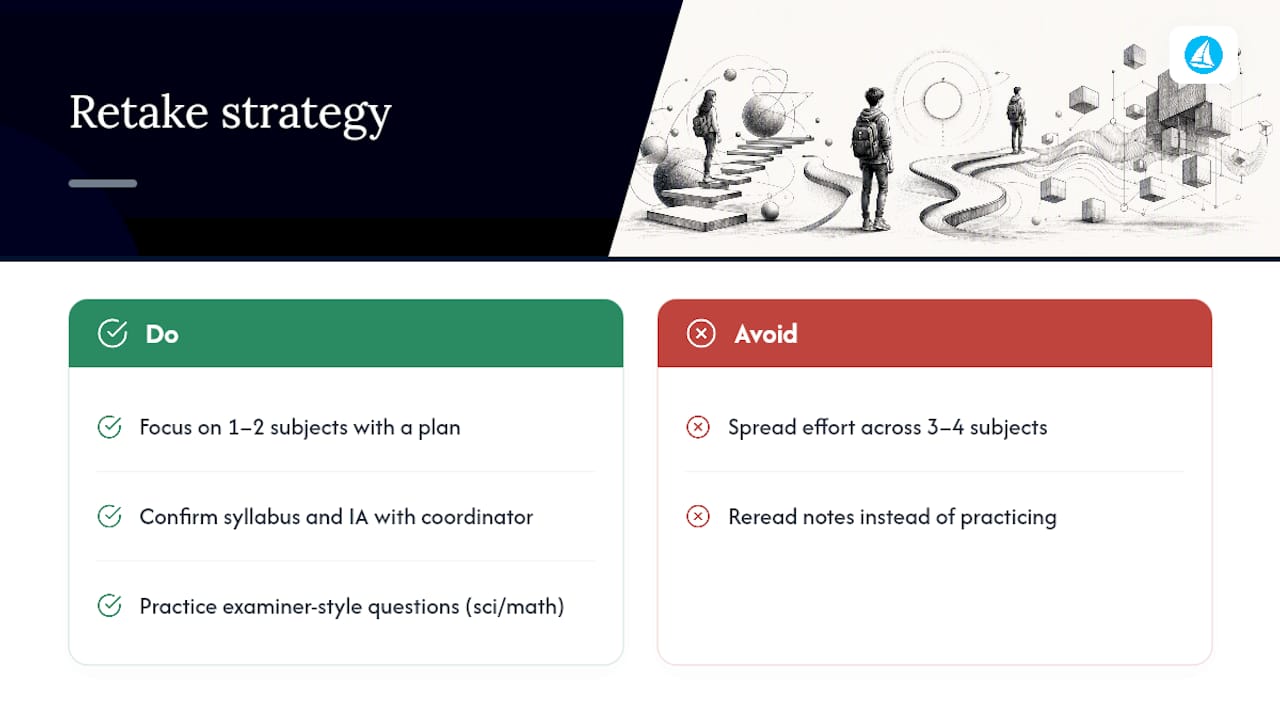
Most students overcomplicate retakes by spreading effort across three or four subjects instead of committing to one or two with a real plan. A single subject, revised against the current syllabus with proper mock feedback, moves a grade far more reliably than a scattered attempt at several.
Confirm the syllabus and IA rules with your coordinator before you open a single revision guide. Everything else follows from that one conversation. For sciences and maths specifically, time spent on examiner-style questions beats time spent rereading notes, every time.
— Oliver
How Tiber Tutor supports your retake preparation
A retake succeeds or fails on how precisely you target the gap that cost you marks the first time, and that is exactly where generic revision falls short. The platform offers exam-style questions, mock exams, and topic tests designed to map directly onto current assessment objectives rather than outdated past papers.
The platform includes syllabus monitoring that helps identify changes since your last sitting to avoid studying content that no longer appears on the exam. Students preparing for a retake typically run timed full-length mocks to establish a baseline, then drill weak topics using examiner-written question banks and student-led answer review, all tracked through progress analytics that show exactly which grade boundary a candidate sits closest to. The platform combines examiner-built content with interlinked tracking across notes, videos, flashcards, and tests. Start with a Biology topic test or explore the full range of subjects on the student plans page after your free 7-day trial.
Sources
For registration and official rules, start with the IB’s own retaking examinations page and its assessment FAQ. Use the Find an IB school tool to locate an administering school, and browse Tiber Tutor’s mock exam and topic test pages for science and maths retake practice.
- Retaking examinations - International Baccalaureate®
FAQ
Are you allowed to retake IB exams?
Yes. There is no rule barring retakes, and the IB has removed its old three-session limit, though your registering school must agree to accept you.
How many times can I retake an IB exam?
There is no official cap on attempts. The practical limit comes from cost, school willingness to register you, and how much a further retake would realistically improve your score.
How many IB subjects can you retake?
You can retake as many subjects as you need to, though most candidates focus on one or two, since the highest grade in each subject counts and spreading revision too thin usually backfires.
What happens if I fail one IB exam?
Failing a single subject does not automatically fail your diploma unless it breaches minimum grade or points thresholds. You can register to retake that subject in a future May or November session through an IB World School.