IB science tutoring options compared: 2026 guide
For most UK IB science students, an examiner-built, analytics-driven online platform is the strongest starting point. Tibertutor delivers exactly that: every question is authored by IB examiners, every topic test maps to the current syllabus, and real-time analytics show precisely where gaps exist before they cost marks. Start with the free 7-day trial and run a baseline mock in your first session.
Table of Contents
- What tutoring options are available for IB sciences in the UK?
- How do these IB science tutoring options compare?
- How do you choose the right IB science tutoring option?
- Why does an analytics-driven, examiner-made platform improve exam readiness?
- What do IB science tutoring options typically cost, and when will you see results?
- How do you trial and integrate an online platform into a 12-week study plan?
- Key takeaways
- The case for stopping passive revision earlier than you think
- Tibertutor: the examiner-built platform built for IB science success
- Useful sources and further reading
- FAQ
What tutoring options are available for IB sciences in the UK?
Five main option types exist. Each suits a different student, budget, and timeline.
- 1:1 private tutors. Best for students who need personalised pacing and direct feedback on exam technique. Main drawback: cost is high, and access to genuine IB examiners is rare.
- Small-group classes. Best for students who learn well alongside peers and want structured teaching at lower cost. Main drawback: pace is fixed to the group, and exam-style practice varies widely by provider.
- School-provided support. Best for students whose teachers are experienced IB practitioners. Main drawback: availability is inconsistent, and analytics or personalised tracking are almost never offered.
- Online platforms and self-study. Best for students who want flexible, syllabus-mapped practice with progress tracking and exam-style questions on demand. Main drawback: requires self-discipline; quality varies enormously between platforms.
- Intensive revision courses. Best for students approaching mock or final exams who need a concentrated boost. Main drawback: expensive per hour, and gains can fade without ongoing structured practice.
Of these five, only online platforms routinely combine examiner-made content, mock exams, and analytics in one place. That combination is what makes the difference for students targeting a 6 or 7.

How do these IB science tutoring options compare?
| Option | Best for | Typical UK cost | Format | Personalisation | Exam-style questions & mocks | Analytics & syllabus tracking | Examiner involvement | Trial / free option |
|---|---|---|---|---|---|---|---|---|
| Online platforms | Self-directed learners; all budgets | Subscription; often under £20/month | On-demand | High (adaptive practice, custom tests) | Yes, extensive | Yes, real-time | Yes (on quality platforms) | Free trial common |
| Live 1:1 tutors | Students needing direct feedback | — | Live 1:1 | Very high | Depends on tutor | Rarely | Occasionally | Trial lesson sometimes |
| Small-group classes | Peer learners on a budget | — | Live group | Low | Varies | Rarely | Rarely | Demo class sometimes |
| School support | Students with strong IB teachers | Included in fees | Live group | Low | Inconsistent | No | Occasionally | N/A |
| Intensive courses | Pre-exam cramming | — | Live group | Low | Sometimes | No | Sometimes | No |
For exam-focused UK IB science students, two options stand out. Online platforms offer the broadest combination of examiner-made content, syllabus tracking, and analytics at the lowest sustained cost. Live 1:1 tutoring with a genuine IB examiner adds direct feedback, but at significantly higher cost and with no guarantee of analytics or structured mock progression. For most students, an online platform is the right foundation; 1:1 tutoring can supplement it for specific weak topics.
How do you choose the right IB science tutoring option?
Work through this checklist before committing to any option.
- Set a specific goal. A target grade (e.g. HL Biology 6), a timeline (12 weeks to mocks), and the topics where you are currently losing marks.
- Check syllabus mapping. Does the resource explicitly map to the current IB syllabus? IB DP Biology SL and HL courses differ significantly in teaching hours, with HL requiring more instructional time to cover additional topics and depth. Every topic should be accounted for.
- Verify examiner involvement. Ask directly: who wrote these questions and mark schemes? Examiner-authored content reflects real command terms and marking logic.
- Confirm analytics and progress tracking. Can you see, by topic, where you are strong and where you are not? Platforms that track syllabus coverage prevent gaps from reaching the final exam.
- Request a mock exam sample. Run one timed mock before subscribing. Check whether the mark scheme matches IB examiner language.
- Check reporting cadence. For teachers: can you see class-level data? For parents: is progress visible without chasing the student?
Questions to ask during any trial:
- “Who wrote these questions, and are they current or former IB examiners?”
- “How does progress tracking map to the IB syllabus by topic?”
- “Can I build a custom test on a single topic I am struggling with?”
- “What does the analytics dashboard show after I complete a mock?”
Red flags to walk away from:
- No named examiner or educator involvement in content creation
- No exam-style mock exams with proper mark schemes
- No progress reporting or syllabus-linked tracking
- Pricing that is opaque or requires a long commitment before a trial
Why does an analytics-driven, examiner-made platform improve exam readiness?
The evidence is clear. A 2023 meta-analysis of 45 studies found that online tutoring matched or exceeded in-person results in 78% of comparisons, particularly when platforms include interactive tools and structured feedback. The same research highlights that online tutor pools can offer 240+ specialists versus the 3–5 options typically available locally, making access to genuine IB examiners far more realistic.
The shift that matters most is from passive re-reading to active, analytics-driven practice as encouraged by effective tutoring programs. Platforms that track syllabus coverage and flag weak topics prevent the most common exam failure: students who feel prepared but have undetected gaps in two or three topics that cost them a grade boundary. Examiner-made content closes that gap because the questions reflect real command terms, real mark-scheme logic, and real exam conditions.
Tibertutor is built on exactly this principle. Its IB science question bank is authored by IB examiners, and every resource — from topic tests and mock exams to IA exemplars and examiner mark schemes — is interlinked within a single platform. The analytics dashboard shows performance by topic, by question type, and across time, giving students and teachers a level of insight that no other IB STEM platform currently offers. Syllabus-aligned study guides shift teaching time from re-explaining theory to applying exam strategy, and Tibertutor’s content is built to do exactly that.
What do IB science tutoring options typically cost, and when will you see results?
| Metric | Detail |
|---|---|
| Online platform subscription | generally low-cost monthly subscription pricing; free 7-day trial available on Tibertutor |
| Live 1:1 tutor (UK market) | a range of hourly rates depending on tutor experience and examiner status |
| Small-group classes | varied hourly costs depending on provider and format |
| Intensive revision course | higher daily rates consistent with intensive revision courses |
| Online vs in-person outcome parity | 78% of comparisons show online matches or exceeds in-person results |
Timeline for measurable improvement: most students see meaningful topic-test score gains within 8–12 weeks of targeted, analytics-guided practice. The key is measuring the right things: not hours studied, but topic-test scores before and after focused practice, and mock exam performance tracked across attempts. Tibertutor’s analytics dashboard makes this visible automatically.
How do you trial and integrate an online platform into a 12-week study plan?
Running your 7-day trial:
- Sign up and complete a baseline mock exam on your weakest subject (Biology, Chemistry, or Physics) in the first session.
- Review the analytics output: note the three topics with the lowest scores.
- Complete one topic test per day for the remaining trial days, focusing on those three topics.
- Check the mark schemes and examiner notes after each test.
- At the end of the trial, re-run a short topic test on your weakest area and compare scores.
12-week study plan (platform-integrated):
- Weeks 1–3: Baseline mock, analytics review, identify priority topics. One topic test per study session. Build your IB study schedule around the analytics output.
- Weeks 4–6: Targeted topic practice using the custom test builder. Use flashcards and cram sheets for high-density recall topics. Review animated videos for concepts that are not yet secure.
- Weeks 7–9: Mixed topic tests across two or three subjects. Begin timed mock exam practice. Review mark schemes immediately after each mock.
- Weeks 10–12: Full mock exams under timed conditions. Analytics review after each mock. Final targeted practice on any remaining weak topics.
For teachers: share the class analytics dashboard with your scheme of work. Set group targets by topic, and use the platform’s data to direct intervention before mock season. Tibertutor’s school adoption features make this straightforward.
Pro Tip: After each mock exam, spend as much time reviewing the analytics as you did sitting the paper. The data tells you exactly where the next mark is coming from.
Key takeaways
For UK IB science students, an examiner-built, analytics-driven online platform is the most cost-effective and evidence-backed starting point for improving exam readiness.
| Point | Details |
|---|---|
| Online platforms lead on value | Examiner-made content, mock exams, and analytics cost far less than equivalent 1:1 tutoring. |
| Examiner involvement is non-negotiable | Questions and mark schemes must reflect real IB command terms; always verify who wrote the content. |
| Analytics prevent hidden gaps | Syllabus-linked tracking identifies weak topics before they cost marks in the final exam. |
| 8–12 weeks for measurable gains | Targeted, analytics-guided practice produces visible score improvement within this window. |
| Tibertutor is the recommended platform | Start with the free 7-day trial and a baseline mock; analytics guide every subsequent study session. |
The case for stopping passive revision earlier than you think
Most students wait too long before switching from notes to exam practice. The conventional advice is to “cover the content first, then practise.” In reality, students who begin exam-style questions early, even on topics they feel uncertain about, build command-term fluency and mark-scheme awareness that passive re-reading never develops. Analytics make this shift less frightening: when you can see exactly which topics need work, there is no reason to delay practice on the ones that are already solid.
The other underestimated factor is the quality gap in content. Not all exam-style questions are equal. Questions written by people who have not marked IB papers often miss the precise language the mark scheme rewards. Tibertutor’s content is authored by IB examiners, which means the questions train the right habits from the first attempt. That is a meaningful advantage, and it is one that no amount of generic past-paper practice fully replicates.
Tibertutor: the examiner-built platform built for IB science success
Tibertutor gives IB science students something no other platform matches: every question, mock exam, and mark scheme is written by IB examiners, and every resource is interlinked within a single, polished platform covering Biology, Chemistry, Physics, and IB Maths. The analytics dashboard tracks your performance by topic and syllabus point, showing exactly where to focus next. No other IB STEM platform offers this depth of progress insight.
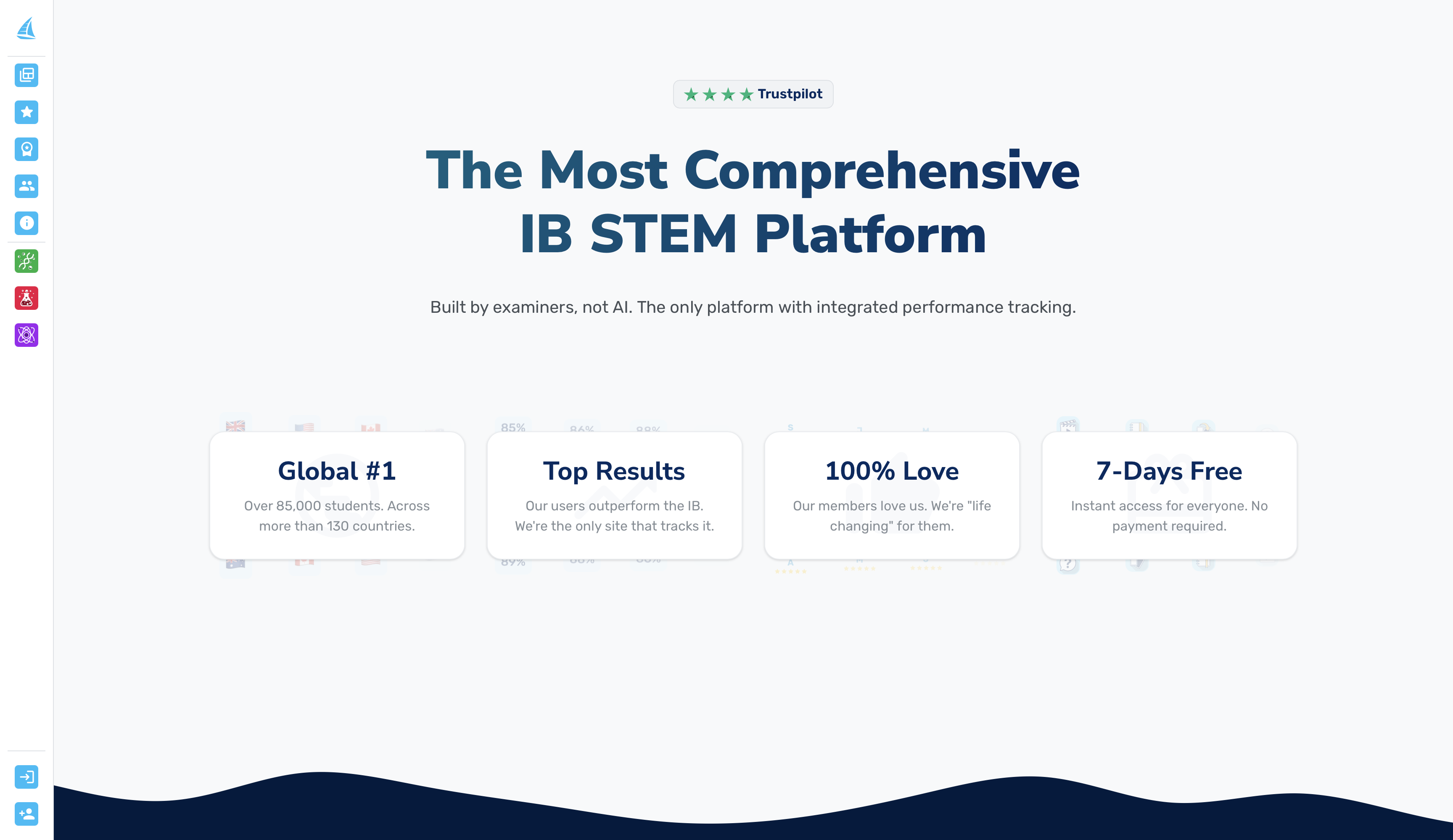
Subscriptions are available monthly, for six months, yearly, or as a full 24-month course package, with school-wide options for teachers and administrators. The free 7-day trial includes full platform access. Start with a Biology mock exam or a Chemistry topic test, review your analytics, and you will know within one session whether this is the right fit. For students who want the best value in IB science preparation, with genuine examiner input and state-of-the-art tracking, Tibertutor is the clear choice. Start your free trial today.
Useful sources and further reading
- IB Biology subject guide — the official course hours and assessment requirements for IB DP Biology; use this to verify that any platform or tutor covers the full syllabus.
- Tibertutor IB science question bank — the platform’s main entry point; includes the custom test builder and free trial sign-up.
- Tibertutor: top IB science resources for 2026 — a curated guide to the resource categories that matter most for IB science exam preparation.
- Tibertutor: top IB science progress tracking tools — explains what good analytics look like and how to use them in your study plan.
- Tibertutor: how to build an IB science study schedule — step-by-step scheduling guidance to complement the 12-week plan above.
FAQ
What is the most cost-effective IB science tutoring option in the UK?
Online platforms with examiner-made content and analytics typically cost under £20 per month, making them significantly cheaper than live 1:1 tutoring (a broad price range per hour influenced by experience and qualifications) while delivering outcomes that match or exceed in-person tutoring in 78% of cases according to a 2023 meta-analysis.
How do I know if an IB science platform uses real examiner content?
Ask directly who wrote the questions and mark schemes. Tibertutor’s content is authored by IB examiners, which means questions reflect real command terms and marking logic rather than approximations.
How long does it take to see improvement with targeted IB science practice?
Most students see measurable topic-test score gains within 8–12 weeks of consistent, analytics-guided practice. The key is tracking performance by topic, not just total hours studied.
Can teachers use an online IB science platform for whole-class tracking?
Yes. Tibertutor’s analytics dashboard supports school-wide adoption, allowing teachers to monitor class performance by topic and align platform data with their scheme of work.
What should I do first on a free trial of an IB science platform?
Run a baseline mock exam in your weakest subject, review the analytics output to identify your three lowest-scoring topics, and then complete one targeted topic test per day for the rest of the trial.