Stop cramming: 3 spaced repetition timetables for IB science exams
Use retrieval based spaced repetition aligned to your syllabus outcomes, prioritise the cards you keep failing, and schedule reviews so the gap between attempts sits at roughly 10 to 20% of the time left until the exam, according to research on optimal spacing gaps. Build your first cards from past paper stems, not textbook summaries. A tool like an online revision platform can help you track which topics need another pass, but the method matters more than the tool.
TL;DR:
- Spaced repetition with review intervals of 10 to 20% of the remaining time until the exam improves long-term retention for IB sciences.
- Prioritize repeatedly failed cards over those you have mastered, especially when accuracy diminishes under timed conditions.
- Use exam-specific question phrasing, command words, and process-oriented tasks to match the cognitive demands of IB assessments.
- Incorporate digital or physical flashcards that test diagram labeling, mechanisms, calculations, and formula derivations tailored to biology, chemistry, and physics.
- Build your revision routine from syllabus outcomes and past paper prompts, adjusting spacing and focus based on performance analytics.
Table of Contents
- Why spaced repetition works for IB science students
- How to build an IB science revision routine that sticks
- Applying spaced repetition to biology, chemistry and physics
- Sample spaced repetition schedules for IB exam windows
- Choosing your tools: apps, Leitner boxes and card hygiene
- How Tibertutor supports a spaced repetition workflow
- What actually happens when you start this
- Getting started with Tiber Tutor
- Sources
- FAQ
Why spaced repetition works for IB science students
The spacing effect describes a simple, well-documented pattern: information reviewed after a gap sticks far better than information crammed in one sitting. Pair it with retrieval practice (actively recalling an answer rather than rereading it) and you get a combination that consistently beats passive revision. A Nature Reviews Psychology analysis of the research calls spacing plus retrieval practice one of the most reliable, underused strategies available to students, and it flags metacognitive regulation, meaning how accurately you judge your own readiness, as the factor that decides whether learners actually use these techniques.
That last point matters more than most revision guides admit. Students consistently believe they know a topic after rereading it once, then discover in the exam hall that recognition is not recall. The classic review by Dunlosky et al. rated distributed practice and practice testing as “high utility” across ages and subjects, ranking them well above highlighting or rereading, which barely moved the needle in comparison.
Statistic callout: A large prospective cohort study of practising physicians, covering 26,258 participants, found that groups using spaced repetition outperformed non-spaced controls on both learning and knowledge transfer, and that double-spaced schedules sometimes beat single repetitions. If spacing shows measurable gains in professionals revising complex clinical material, the same logic holds for IB biology, chemistry and physics content.
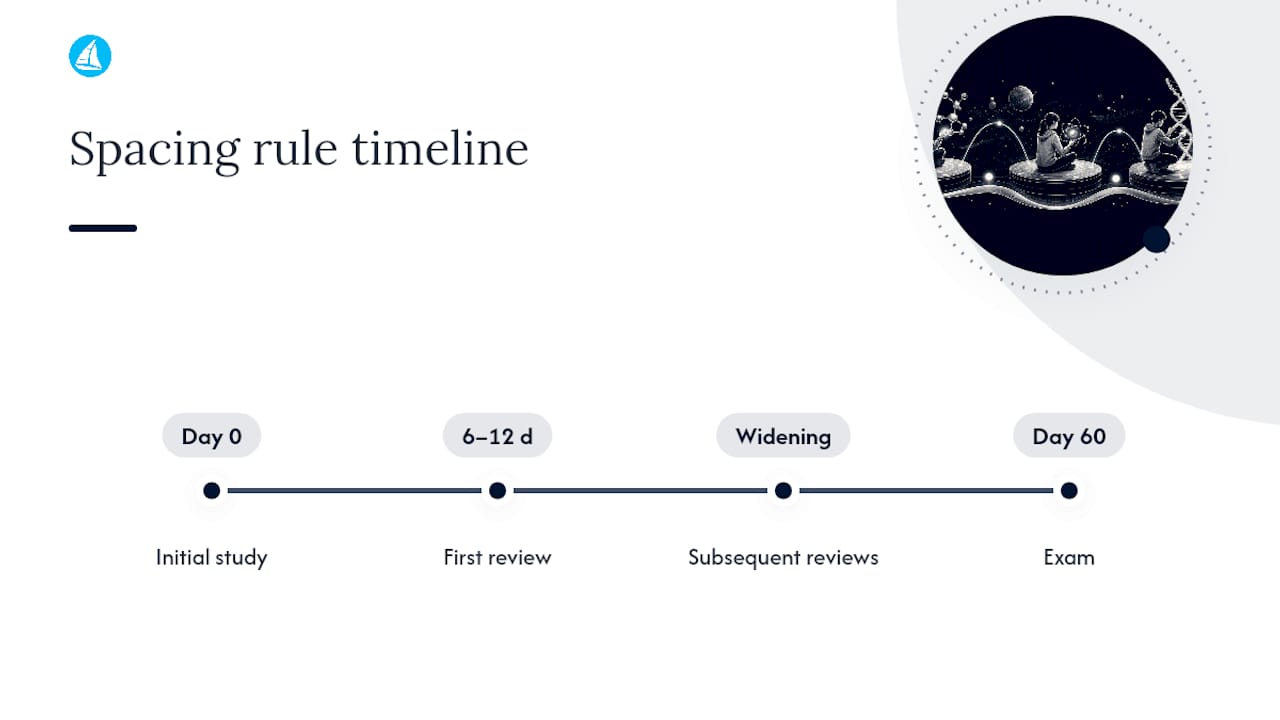
On timing, Cepeda et al.'s spacing review offers a workable rule: the ideal gap between review sessions is roughly 10 to 20% of the time remaining until the test. Revise a topic 60 days before your exam, and your next review should land somewhere between 6 and 12 days later, not the next morning. This is why SRS software and analytics dashboards earn their place here: they correct the guesswork that comes from relying on how confident a topic feels rather than how well you can actually reproduce it under pressure.
How to build an IB science revision routine that sticks
Turn the theory into a routine you can start today, using your syllabus and past papers as raw material rather than a textbook contents page.
- Extract outcomes, not chapters. Open the IB subject guide and turn each syllabus statement into a question. “Outline the process of oxidative phosphorylation” becomes a card asking exactly that, not a page reference.
- Mine past paper command terms. Command terms like “explain,” “compare,” and “deduce” signal the depth examiners expect. Write cards that demand that exact depth, ideally lifted from real exam-style phrasing.
- Set your first review at day one, then scale using the 10–20% rule. A card you plan to need in three weeks gets its second review around day two or three, then further out as your confidence grows.
- Prioritise by failure, not by date. A card you keep getting wrong needs more airtime than one you have nailed five times, regardless of what the calendar says.
- Run short daily blocks with interleaving. Fifteen to twenty minutes mixing biology, chemistry and physics cards beats an hour on a single subject, because switching between topics forces genuine retrieval rather than pattern-matching.
- Set a weekly review quota. Aim to clear your entire due pile each week; a backlog of unreviewed cards defeats the whole system.
Pro Tip: Time yourself answering each card as if it were an exam question. If you cannot produce a full answer in the time a similar mark allocation would give you in the real paper, the card is not “learned” yet, no matter how familiar it feels.
A study plan built around syllabus-aligned resources makes this far easier to sustain than building a routine from scratch, particularly once multiple subjects are competing for the same revision hours.
Applying spaced repetition to biology, chemistry and physics
Each IB science subject rewards a different card style, and treating all three the same way wastes review time.
- Biology rewards labelled diagram recall, mechanism-explanation prompts, and command-term drilling. A strong card might show a blank diagram of the electron transport chain and ask you to label and explain each stage, mirroring how IBDP biology exam questions are actually structured.
- Chemistry needs cards for reaction conditions, stepwise mechanisms, and calculation sequences. Rather than “what is the formula for moles,” write “given this mass and molar mass, calculate moles, showing each step,” because IB chemistry marks process as much as final answers. Add spectrometry interpretation cards showing a mass spectrum or NMR trace and asking for structural deductions.
- Physics benefits from formula-derivation prompts (not just formula recall), questions on what each variable physically represents, graph interpretation cards, and staged numerical problems that build from one sub-question to the next, exactly as paper 2 questions tend to escalate.
The common thread across all three: a card should demand the same cognitive work the exam demands, not a simplified version of it.
Sample spaced repetition schedules for IB exam windows
Two schedule types dominate the research: fixed intervals (same gap every time) and expanding intervals (gaps grow as confidence grows). Cepeda’s review suggests expanding schedules suit short test delays of days to weeks, while fixed, longer gaps tend to work better across a full academic term.
- One-month cram: Review new cards after 1 day, then 3 days, then 6 days, sitting a full topic test in the final week.
- Eight-week term revision: Review at day 1, day 5, day 12, and day 25, adding a mock exam at week 6 as a spacing anchor.
- Whole-course retention plan: Revisit each unit monthly from the point it is taught, with intensity increasing to weekly once exams are within eight weeks.
Worked example: a chemistry topic taught in September, with exams in May, gets its first review in early October, its second around late October (roughly 15% of the seven-month gap), then progressively longer spacing until weekly reviews begin in March.
Choosing your tools: apps, Leitner boxes and card hygiene
Software-based spaced repetition systems track your accuracy automatically and resurface failed cards without you doing the arithmetic yourself. The Leitner box method, physical cards sorted into boxes by review frequency, works just as well for students who concentrate better away from a screen, though it demands more manual discipline to keep moving cards correctly.
- Write one fact or one task per card; a card testing three things at once tells you nothing useful when you get it wrong.
- Use exam-authentic language and command terms, never simplified textbook phrasing.
- Back up digital decks regularly, and keep a simple record of your weakest topics so a lost app or a dropped box does not erase months of prioritisation data.
Pro Tip: A detailed guide to cram sheet construction is a good companion once your cards are built. Cram sheets consolidate what spaced repetition has already taught you, rather than replacing the process.
How Tibertutor supports a spaced repetition workflow
Some IB biology, chemistry and physics resources are written by IB examiners and experienced educators, with content mapped directly to syllabus outcomes rather than generic textbook chapters. Its topic tests may help generate weak-topic lists automatically, so users can identify which cards need building without manually auditing every past paper.
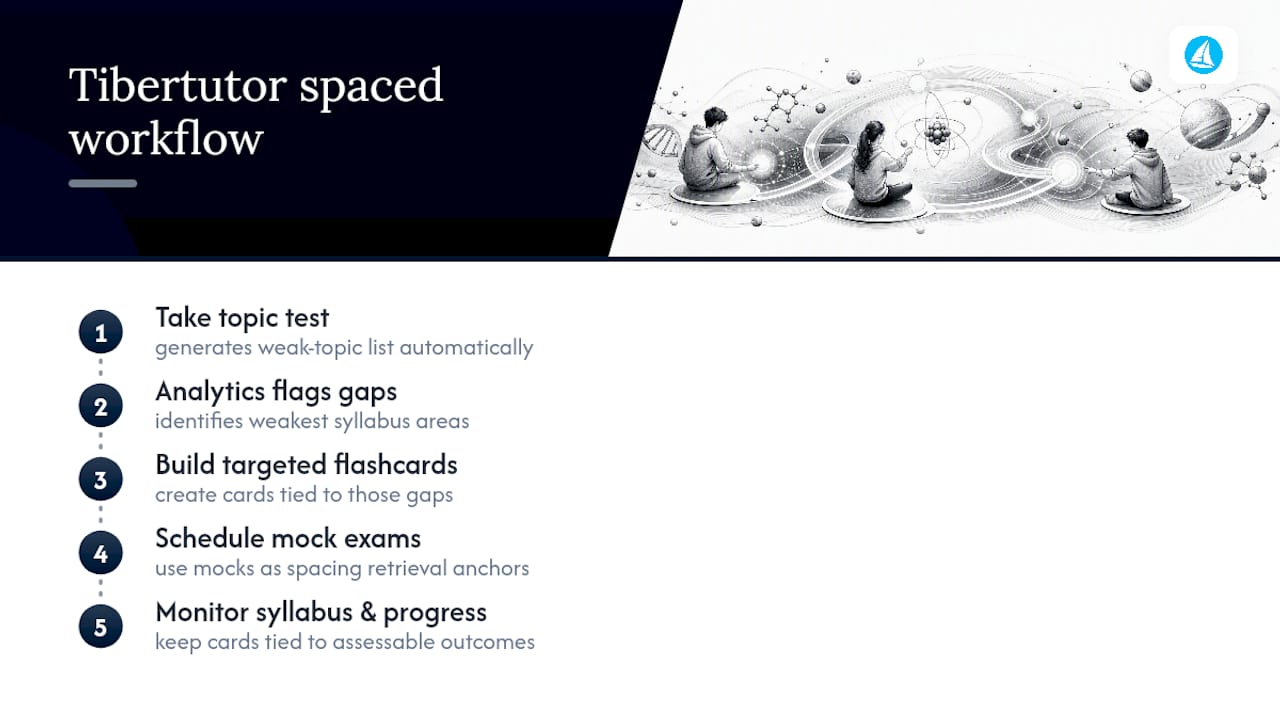
That workflow mirrors the practical steps above almost exactly: sit a topic test, let the analytics flag your weakest areas, build targeted flashcards for those gaps, then schedule mock exams as natural spacing anchors that force retrieval under exam conditions. Syllabus monitoring can keep cards tied to real assessable outcomes, and progress tracking features can replace the manual guesswork students rely on when deciding what to review next.
What actually happens when you start this
The first two weeks feel slow. Building cards takes longer than passive rereading, and progress feels invisible until week three or four, when recall starts outpacing effort. Pick one topic you find hardest and start there; the system improves with use, not with planning.
— Oliver
Getting started with Tiber Tutor
An online revision platform can offer exam-style questions, mock papers, and topic tests, interlinked so a weak result on one test points you to the flashcards and notes that help improve understanding. Such interlinking offers an advantage over piecing together free resources from multiple sites, helping keep revision anchored to relevant exam content.
Start with the IB Biology topic tests or IB Chemistry topic tests to see where your weak topics actually sit, then work through the flashcards and notes tied to those results before booking a IB Physics mock exam as your next spacing anchor. Free trials often give enough time to run a topic test, export a weak-topic list, and build a deck of retrieval cards before committing to a subscription.
Sources
Key studies: Nature Reviews Psychology, Dunlosky et al., Cepeda’s spacing review, and the IBO subject guides for official syllabus outcomes.
- The science of effective learning with spacing and retrieval practice | Nature Reviews Psychology
- Improving Students’ Learning With Effective Learning Techniques
- Using spacing to enhance diverse forms of learning: review and implications (Cepeda et al.)
- The effect of spaced repetition on learning and knowledge transfer in a large cohort of practising physicians (PubMed)
FAQ
What is the 1-3-5-7 rule for studying?
It is a simple fixed schedule where you review new material after 1, 3, 5, and 7 days, spacing each session further apart as retention builds. It works reasonably well for short-term recall but the 10 to 20% test-delay rule gives a more precise guide for exams further away.
What is an example of spaced repetition?
Reviewing a biology diagram on day one, again on day three, then again on day nine before an exam three weeks later is a working example, with each gap widening as your recall improves.
What is the 3-2-1 memory technique?
Definitions of this vary and it is not a standardised, research-backed framework in the way the spacing effect is. Most versions describe reviewing material three times in decreasing frequency, but the underlying spacing principle matters more than the specific numbers attached to any named rule.
How do I know when to prioritise a card for review?
Prioritise any card you answer incorrectly or hesitate on over cards you complete confidently, since accuracy under time pressure is a better signal than how recently you studied it. Platforms like Tibertutor automate this by flagging weak topics through topic test results.
Can spaced repetition work for calculation-heavy subjects like physics and chemistry?
Yes, though cards need to test full working, not just final answers, since IB mark schemes reward process as heavily as the result itself.