
IB science cram sheet best practices: your exam guide
The seven IB science cram sheet best practices are: prioritise by exam frequency, compress content to single-line facts, use a structured A4 layout, colour-code by topic, build iteratively from mock results, practise closed-book recall against the sheet, and integrate it with spaced practice rather than replacing it. Follow these and your cram sheet becomes a precision recall tool, not a security blanket.
TL;DR: Distributed practice outperforms massed cramming by a meaningful margin in recall studies. A cram sheet works best as a final-stage retrieval prompt after weeks of spaced practice. Tibertutor’s examiner-built templates and analytics make building one faster and more accurate than starting from scratch.
Quick-start checklist:
- List only formulas, constants, units, command terms, and single-line definitions
- Limit yourself to one A4 page per subject
- Colour-code by topic or syllabus section
- Update the sheet after every mock test using your error data
- Use it for closed-book recall checks, not passive rereading
Table of Contents
- What should you actually put on an IB science cram sheet?
- How should you design and format your cram sheet?
- When and how should you create your cram sheet?
- How do you use a cram sheet in the final 48–72 hours?
- Practical one-page templates for Biology, Chemistry, and Physics
- Why cram sheets cannot replace distributed practice
- Key takeaways
- What examiners actually notice in your answers
- Tibertutor gives you examiner-built tools for smarter revision
- Useful sources for further reading
- FAQ
What should you actually put on an IB science cram sheet?
Space on a cram sheet is a finite resource. Every item you add displaces something more valuable, so the selection process matters as much as the layout.
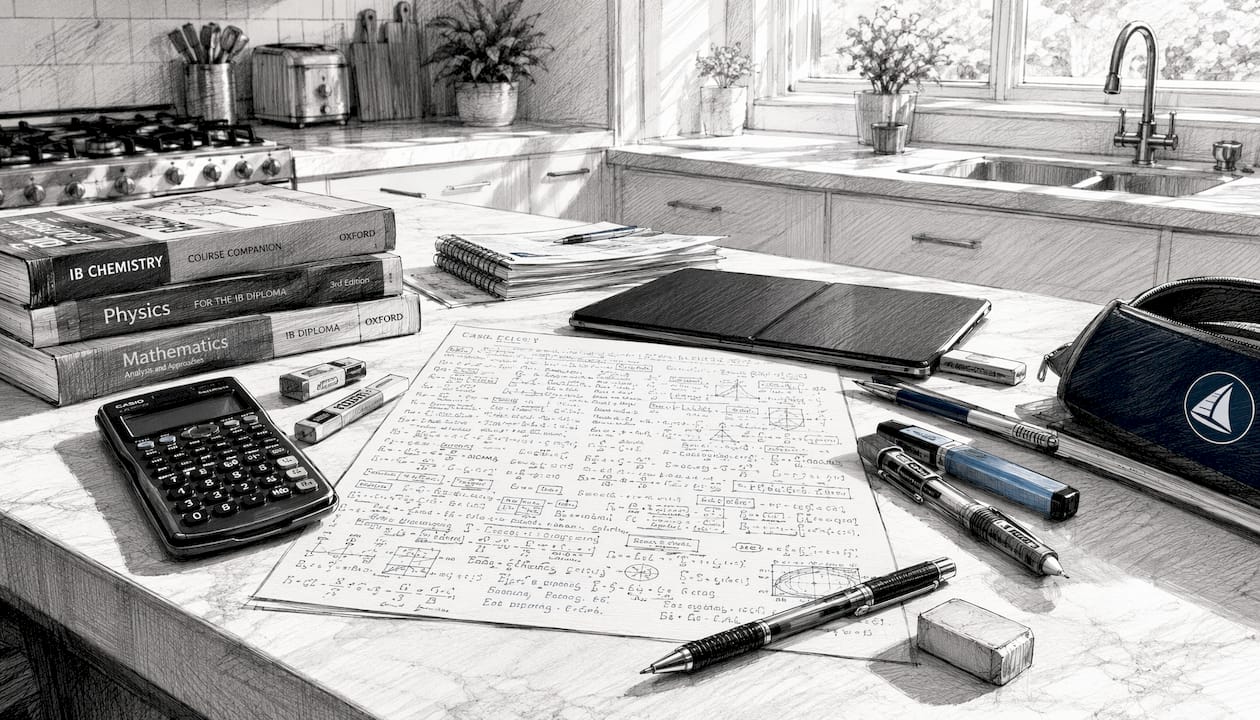
The highest-value items per square centimetre are formulas, physical constants, SI units, command-term definitions, and single-line concept summaries. Diagrams earn their place only when a labelled sketch genuinely replaces several lines of text — think the structure of a chloroplast or a circuit diagram for electromagnetic induction.
Subject-specific must-haves:
| Subject | Priority items |
|---|---|
| Biology | Pathway summaries (photosynthesis, respiration), labelled diagrams, precise definitions, common examples |
| Chemistry | Key equations, equilibrium expressions, acid-base reminders (pKa/pKb), unit conventions |
| Physics | Core formula list, vector sign conventions, SI unit reminders, constant values |
What to leave off: full derivations, long prose explanations, and anything you already recall reliably. The IB Biology HL common mistakes guide is a useful reference for spotting the gaps that actually cost marks.
To decide what stays, run through your most recent mock paper and note every question where you lost marks due to a forgotten fact, not a misunderstood concept. Those items belong on the sheet. Everything else is a candidate for removal.
Pro Tip: Write each item as an “exam phrase” — the exact wording you would write in an answer. “Enzyme active site is complementary in shape to substrate” is more useful than “enzymes are specific.”
How should you design and format your cram sheet?
A cram sheet you cannot scan in ten seconds under pressure is not doing its job.
A4 portrait works well for most students because it mirrors the paper you write on in exams, making it easier to visualise during retrieval. Landscape suits Physics students who need wide formula tables. Font size should be no smaller than 8pt for body text and 10pt for headings — anything smaller becomes unreadable when you are anxious and short on time.
Layout options compared:
| Layout | Best for | Drawback |
|---|---|---|
| Single-column dense | Short content lists, definitions | Hard to scan quickly |
| Two-column topic split | Biology pathways, Chemistry reactions | Needs careful planning |
| Quadrant (four sections) | Physics formula groups | Less flexible for uneven content |
Colour-coding is worth the extra minute it takes. Assign one colour per syllabus topic and apply it consistently across headings, boxes, and diagram labels. When you recall information during an exam, the colour acts as a retrieval cue that links the fact to its topic cluster.
- Use bold for formulas and constants; italics for command-term definitions
- Box “must-know” items in a solid border; “useful-to-know” items in a dashed border
- Leave a narrow margin for last-minute additions after your final mock
Pro Tip: Pair a colour with a simple shape (e.g. a blue circle for all thermodynamics content). The dual cue — colour plus shape — strengthens the memory link to that syllabus area.
When and how should you create your cram sheet?
Timing matters. A cram sheet built the night before an exam is a panic document. One built over several weeks, refined after each mock, is a precision tool.
A practical IB science study schedule integrates cram-sheet drafting into the revision cycle from the start, not as a last-minute addition.
Recommended workflow:
- After your first full revision pass of a topic, draft a rough sheet with every item you think matters.
- Sit a topic test or practice paper without the sheet.
- Review your errors and cross-reference with your sheet. Add missing items; remove anything you answered correctly without needing it.
- Condense remaining items into shorter, sharper phrasing.
- Repeat steps 2–4 after each mock exam.
- Finalise the sheet one week before the exam. No major additions after that point.
University learning centres consistently recommend short, focused study sessions of 30–45 minutes with active strategies rather than marathon sessions. Drafting or reviewing your cram sheet fits naturally into this rhythm — treat it as a 15-minute task at the end of a session, not a separate project.
Peer review adds a useful check: ask a classmate to read your sheet and flag anything ambiguous or missing. But keep personalisation central. A sheet built around your errors outperforms a generic one every time.
How do you use a cram sheet in the final 48–72 hours?
The cram sheet’s job in the final revision window is to test your memory, not fill it. Passive rereading at this stage gives you false confidence without improving retrieval.
A structured final-day routine:
- Cover the sheet completely.
- Write from memory everything you can recall on a blank page (20 minutes).
- Uncover the sheet and check. Mark every gap.
- Spend 5 minutes reviewing only the gaps — not the whole sheet.
- Repeat the cycle once more before sleep.
On exam morning, a single 10-minute read-through is enough. You are priming retrieval, not learning new material. Retrieval practice consistently outperforms rereading for exam performance, and this routine puts that principle into practice.
- Pair the sheet with flashcards for definitions and command terms
- Use past-paper questions as timed drills, then check your answers against the sheet
- Avoid adding new content in the final 24 hours — it crowds out what you already know
Pro Tip: The night before the exam, write out your three most-feared formulas from memory. If you can do it without checking, you are ready. If you cannot, those three items get one final focused review.
Practical one-page templates for Biology, Chemistry, and Physics
A template gives you a starting structure so you spend your time filling it, not designing it. These outlines are calibrated to a single A4 page.
| Subject | Section | Approx. space |
|---|---|---|
| Biology | Pathway diagrams + labels | 30% |
| Biology | Precise definitions | — |
| Biology | Command-term reminders | 20% |
| Biology | Quick examples | 15% |
| Biology | Units and constants | 10% |
| Chemistry | Key equations and equilibria | — |
| Chemistry | Definitions and pKa reminders | — |
| Chemistry | Units and constants | 20% |
| Chemistry | Command terms | 20% |
| Physics | Core formula list | — |
| Physics | Vector and sign conventions | 20% |
| Physics | SI units and constants | 20% |
| Physics | Diagram prompts | 20% |
HL students should allocate slightly more space to higher-order content (HL-only topics, extension material) and reduce the quick-examples section accordingly. SL students can use the freed space for additional definitions.
Convert longer notes into exam phrases by asking: “What is the minimum I need to write in an answer to earn this mark?” That answer is your cram-sheet entry.
Tibertutor’s examiner-built resources include syllabus-aligned templates and questionbank analytics that show which topics appear most frequently in past papers — exactly the data you need to populate these templates accurately.
Pro Tip: Use your Tibertutor topic-test results to rank syllabus sections by your personal error rate. Fill the template in that order: highest error rate first, lowest last.
Why cram sheets cannot replace distributed practice
“Distributed practice and retrieval practice are among the most effective learning strategies identified in cognitive research. A meta-analysis of many studies found spaced practice delivers substantially better long-term recall than massed study — a gap that compounds over a full exam season.” — Scientific American
John Dunlosky’s landmark review, published in Psychological Science in the Public Interest, rated distributed practice and retrieval testing as the two highest-utility learning techniques across all student types and subject areas. Summarising and highlighting — the techniques most students rely on — rated low utility when used alone.
A cram sheet is a summary document. Used passively, it carries the same limitations as any other passive technique. Used as a retrieval prompt after genuine spaced practice, it becomes genuinely useful.
- Spend at least 70% of your revision time on spaced practice and past-paper questions
- Reserve the cram sheet for the final 30% of your revision window
- Never use the sheet as your primary source of learning for a topic you have not yet studied properly
The step-by-step IB revision guide from ESS Tutor offers a useful sequencing model that keeps spaced practice central while building in targeted review sessions — the same principle applies across IB sciences.
Key takeaways
A well-built IB science cram sheet, grounded in mock-exam data and used for active recall, is one of the most efficient tools in your final revision window.
| Point | Details |
|---|---|
| Prioritise by error rate | Fill your sheet with items you lost marks on in mocks, not items you already know. |
| Keep it to one A4 page | Space limits force you to select only the highest-value facts per subject. |
| Build iteratively | Draft early, prune after each mock, and finalise one week before the exam. |
| Use for active recall only | Cover the sheet, write from memory, then check — never read it passively. |
| Use Tibertutor analytics | Tibertutor’s mock exams and progress tracking identify your highest-priority topics, making cram-sheet assembly faster and more accurate. |
What examiners actually notice in your answers
The most common error I see in IB science scripts is not a missing formula — it is imprecise language. Students often understand a concept but lose marks because their phrasing does not match what the mark scheme requires. A cram sheet built around exact examiner phrasing, rather than paraphrased notes, directly addresses this.
Command terms are the clearest example. “State” requires a single factual sentence. “Explain” requires a mechanism. Students who confuse the two lose marks on questions they understand. A cram sheet that lists command-term definitions alongside the content they apply to trains you to respond correctly under pressure.
Diagrams are similarly underused. A single, accurately labelled diagram of the electron transport chain, drawn from memory in an exam, can earn three or four marks in one move. The students who achieve this have practised drawing it from a prompt on their cram sheet, not from copying it repeatedly from a textbook. Tibertutor’s exam technique guidance reinforces exactly this point — examiner-standard phrasing and diagram accuracy are learnable skills, not innate ones.
Tibertutor gives you examiner-built tools for smarter revision
Most IB students spend hours deciding what to put on a cram sheet. Tibertutor removes that guesswork entirely. The platform is built by actual IB examiners, which means every template, question, and mark scheme reflects exactly what earns marks in a real exam — not a generic approximation of it.

The analytics are what set Tibertutor apart. After completing IB Biology or Chemistry mock exams, you get a detailed breakdown of your performance by topic and question type. That data tells you precisely which syllabus areas belong on your cram sheet and which you can safely leave off. No other IB platform offers this level of integrated, examiner-informed feedback alongside printable templates, animated videos, flashcards, and a full questionbank — all in one place.
Subscriptions are available monthly, termly, or for the full two-year course, with a free seven-day trial to start. See the full range of options at Tibertutor pricing and begin your trial today.
Useful sources for further reading
| Source | Why it helps |
|---|---|
| Dunlosky et al., Psychological Science in the Public Interest | The definitive cognitive-science review of ten learning techniques; rates distributed practice and retrieval testing as highest utility. |
| Scientific American: best ways to study | Accessible summary of spaced vs massed practice research; useful for understanding why cram sheets must complement, not replace, spaced study. |
| Cornell Learning Strategies Center | Practical guidance on retrieval practice and interleaving; directly applicable to cram-sheet use routines. |
| UNC Learning Center: Study Smarter | Evidence-based advice on session length and active strategies; supports the 30–45 minute session model. |
| Tibertutor IB Science Resources | Examiner-built templates, mock exams, and analytics for Biology, Chemistry, and Physics — the fastest way to build an accurate, syllabus-aligned cram sheet. |
| ESS Tutor: IB exam strategies | Partner resource with practical revision workflows applicable across IB science subjects. |
FAQ
What should go on an IB science cram sheet?
Prioritise formulas, constants, SI units, command-term definitions, and single-line concept summaries. Include labelled diagrams only where a sketch replaces several lines of text.
How long should an IB science cram sheet be?
One A4 page per subject. The space constraint forces you to select only the highest-value items, which is the point.
When is the best time to start building a cram sheet?
After your first full revision pass of each topic, then update it after every mock exam. Finalise it one week before the exam.
How do I use a cram sheet without just rereading it?
Cover the sheet, write everything you can recall on a blank page, then check your gaps. Retrieval practice consistently outperforms passive rereading for exam performance.
How does Tibertutor help with cram-sheet creation?
Tibertutor’s mock exams and topic tests generate performance analytics that identify your highest-priority topics, and its examiner-built templates give you a syllabus-aligned starting structure for Biology, Chemistry, and Physics.