IB Physics C3 Notes
This page contains our IB Physics notes for C3. By reading each one of these notes, you will fully cover the content for IB Physics 'Further wave phenomena'.
Chapters
Further single slit diffraction
Remember that a single-slit diffraction pattern contains a central maximum intensity followed by minima and maxima of decreasing amplitude and intensity, as shown below:
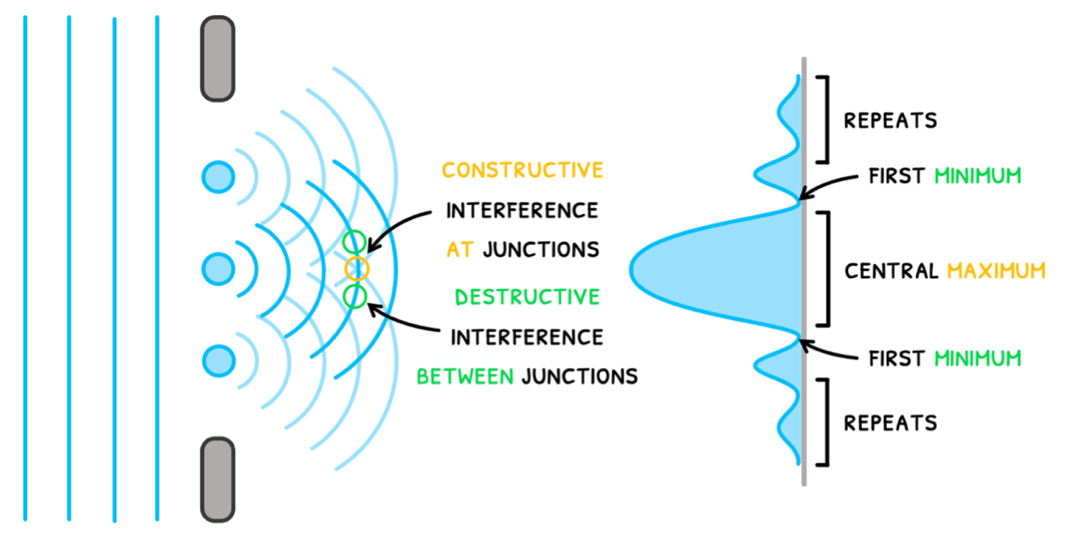
To calculate the angle of the first minimum (θ), based on slit width (b) and wavelength (λ), use the formula:
If the angle is less than 12.5°, small angle approximation can be used, changing the formula to:
The relative intensities and amplitudes of the first few maxima are outlined in the table below:
| Maximum | Central | 1st maximum | 2nd maximum |
|---|---|---|---|
| Amplitude | Amax | 1/3rd Amax | 1/5th Amax |
| Intensity | Imax | 1/9th Imax | 1/25th Imax |
tibertutor.com
Next Up
You have completed the sub-topic C3 notes, covering "Further wave phenomena" for IB Physics - continue with related resources below or explore the full IB Physics course from the IBO.
Other Sub-topic C3 resources