Final 90 Days: Examiner Led Checks Parents Need for IB Science & Maths
The IB Diploma runs exams in two sessions, May and November, and grades every subject from 1 to 7 against a 45-point maximum, including up to 3 core points. Your three jobs this term are simple: confirm your child’s exact session and timetable with the school, check the exam rules for permitted equipment, and build a concrete revision plan around past papers rather than vague extra hours.
TL;DR:
- Most students should focus on finishing all coursework and submissions at least three months before exam day to maximize revision time.
- Starting past-paper practice around 60 days before exams enhances familiarity with question types and reduces last-minute stress.
- Confirm the exact exam session, timetable, and digital format details with the school rather than relying on informal rumors or assumptions.
- Maintaining a consistent sleep routine and tracking exam logistics helps prevent avoidable mistakes on exam day.
- Using examiner-authored resources and analytics can identify weaker topics early, allowing targeted review during the final preparation phase.
Table of Contents
- Understanding the IB exam schedule and formats
- How do IB exams turn into a diploma score?
- What role do internal assessments, the extended essay and TOK play?
- What are the exam-room rules parents should check?
- Building a realistic revision timeline before exam day
- How examiner-authored resources and Tiber Tutor support this plan
- What other support is available beyond revision resources
- A short checklist from Oliver
- Where Tiber Tutor fits into your family’s final stretch
- Sources
- FAQ
Understanding the IB exam schedule and formats
The IB Diploma Programme runs its main exam sessions in May and November each year, with May results typically released in early July. November is generally the smaller session, used by schools in the southern hemisphere or those running a staggered academic year, so check which one applies to your child.
The single most important document you will handle this year is not published by the IB at all. It is the timetable your school’s IB Coordinator issues, listing your child’s actual exam dates, room allocations and start times. The official IB exam schedule sets the overall session windows, but only the school knows your child’s specific paper order and whether any subjects clash.
A growing number of subjects now run as digital exams rather than paper-based ones, and the format affects revision. Digital papers change how students annotate diagrams, manage on-screen timers and navigate between questions, so it is worth asking directly whether your child’s subjects are affected this cycle.
- Confirm whether your child sits in May or November, and get the written timetable from the school, not a class rumour.
- Ask the IB Coordinator whether any of your child’s subjects use digital exam papers this year.
- Check your local timezone against the official session, since some exams run at fixed times globally, not local school hours.
How do IB exams turn into a diploma score?
Each of the six subjects is graded on a scale of 1 to 7, and those six scores combine with up to 3 additional core points from Theory of Knowledge and the Extended Essay, giving a maximum total of 45 points. Most competitive university offers generally require a total diploma score well above the minimum passing threshold, though requirements vary enormously by course and country.
Passing the diploma is not simply about hitting a target number. The IB sets several conditions that must all be satisfied, and missing any one of them can mean the diploma is not awarded even if the total score looks respectable.
- A minimum of 24 points overall, though most successful candidates score well above this.
- No grade below 2 in any subject, and no more than one grade of 3 across all six.
- At least 12 points combined from higher-level subjects.
- A combined score of at least 1 out of 3 for the TOK and Extended Essay core.
Predicted grades, the ones your child’s teachers submit before final exams, are professional estimates based on classwork and mock performance. They are not the final grade, and moderation of internal assessments can shift the actual outcome up or down. If results look markedly out of line with predictions, the IB assessment FAQ explains how to request an Enquiry Upon Results, which can include a re-mark of specific papers. Understanding how mark schemes and assessment criteria actually work makes it far easier to judge whether a recheck is worth pursuing.
What role do internal assessments, the extended essay and TOK play?
Alongside the written exams, every IB student completes coursework that the school submits directly to the IB: Internal Assessments (IAs) for each subject, the Extended Essay, and Theory of Knowledge tasks. The official parent guide describes these three elements as the DP core, and together they can be worth a significant share of a subject’s final grade, particularly in the sciences where lab-based IAs often carry 20% or more.
Deadlines for these pieces typically fall well before the exam session itself, often in the first half of the final academic year, because the school needs time to mark, moderate and upload them before its own IB deadline.
- Log your child’s IA submission dates for each subject as soon as the school confirms them.
- Track the Extended Essay supervisor meeting schedule and the final draft deadline separately.
- Check that TOK exhibition and essay components are logged with their own dates, since they run on a different timeline to subject IAs.
- Confirm with the school that all components have actually been uploaded, not just drafted.
Your role here is logistical, not academic. Help with formatting, printing, backing up files and keeping a shared calendar of deadlines. Reading a draft for structure is reasonable; rewriting paragraphs is not, and it can create academic integrity problems for your child. For a fuller picture of how these submissions work day to day, the guide to IB internal assessment walks through typical supervisor expectations.
What are the exam-room rules parents should check?
Exam rules are strict and mostly consistent across IB schools worldwide, but a handful of avoidable mistakes cause real disruption every session. Phones, smartwatches and any device with communication or storage capability are prohibited in the exam room, and the safest approach is to leave them at home rather than trust a bag under the desk.
- Transparent pencil case with pens, pencils, eraser and ruler.
- Approved scientific or graphic calculator, reset to exam mode with a fresh battery.
- Clear or unlabelled water bottle.
- Student ID card or the identification the school specifies.
- Nothing electronic beyond the approved calculator, including smartwatches.
Calculator checks matter more than most parents expect. Many science and maths papers require the calculator’s memory to be cleared beforehand, and a device flagged with stored programs can be confiscated mid-exam. Run this check together the night before, not the morning of.
Pro Tip: Do a full “exam bag” check the evening before each paper, calculator included, so the morning of the exam is about breakfast and calm, not a scramble for a spare pencil.
If your child has a legitimate reason to arrive late, needs extra time, or requires any special arrangement, that conversation needs to happen with the IB Coordinator well in advance. Arrangements agreed on the day rarely get approved in time.
Building a realistic revision timeline before exam day
Examiner-backed guidance consistently recommends starting focused, timed past-paper practice three to six months before exams, not cramming content in the final fortnight. A 90-day framework gives structure without demanding an unrealistic schedule.
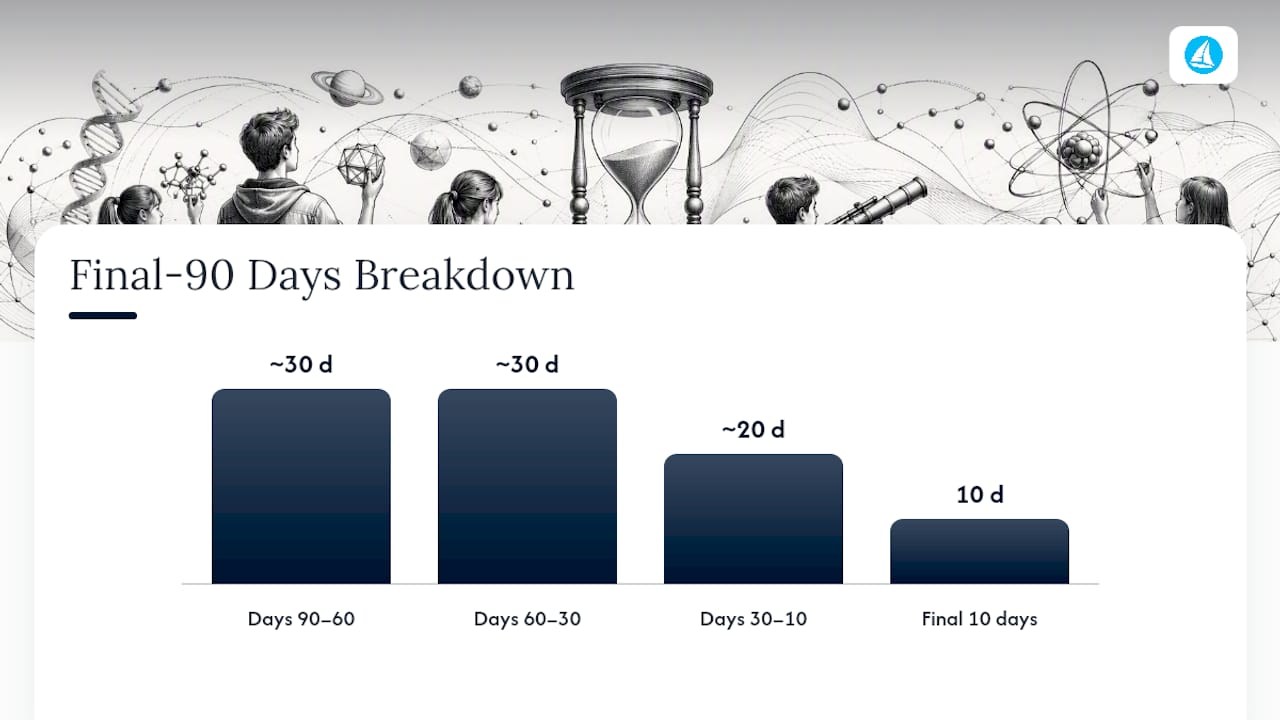
- Days 90 to 60: finish outstanding IA and Extended Essay submissions completely, so revision time later is not competing with coursework deadlines.
- Days 60 to 30: ramp up timed past-paper practice across all subjects, prioritising the ones with the biggest gap between predicted and target grade.
- Days 30 to 10: shift towards exam technique, mark-scheme alignment and command-term precision rather than new content.
- Final 10 days: taper the workload, run light review sessions, and protect sleep over extra hours.
A focused final-90-days plan that triages submissions first, then past-paper technique, tends to produce less stress and better outcomes than adding indiscriminate extra study hours in the final weeks.
An error log turns mock exams into something genuinely useful. For every past paper attempt, your child should note the topic, the command term (explain, evaluate, discuss), and why marks were lost: content gap, misreading the question, or running out of time. Patterns across subjects usually point to one or two fixable habits, often around command-term interpretation rather than missing knowledge.
Sleep and routine matter more than an extra revision hour most evenings. A tired brain retains less and makes more careless errors under timed conditions, so protecting a consistent bedtime through the final stretch is not indulgent, it is strategic. If a specific science or maths subject stays stubbornly weak despite consistent practice, that is the point to consider examiner-led tutoring or a targeted subject platform rather than more unstructured hours. The guide to managing IB exam stress covers practical routines worth building into this stretch.
How examiner-authored resources and Tiber Tutor support this plan
Turning a 90-day plan into daily action is where most families lose momentum, and it is exactly where Tiber Tutor is built to help. The platform offers examiner-authored question banks, full mock exams, a custom test builder and syllabus monitoring across Biology, Chemistry, Physics and Maths, with progress analytics that show exactly where marks are being lost by topic and command term.
A simple weekly workflow works well alongside school teaching:
- Run one timed mock or topic test through Tiber Tutor each week, matched to what the class is currently covering.
- Review the student-led answer review against the examiner mark scheme immediately afterwards, while the paper is still fresh.
- Check the analytics dashboard together once a week to spot recurring weak topics before they compound.
- Bring specific analytics findings to parent evenings, so conversations with teachers focus on named gaps rather than general worry.
Because the content is written by practising IB examiners and kept aligned to the current syllabus, the feedback your child gets mirrors what a real marker would flag, not a generic guess at difficulty.
What other support is available beyond revision resources
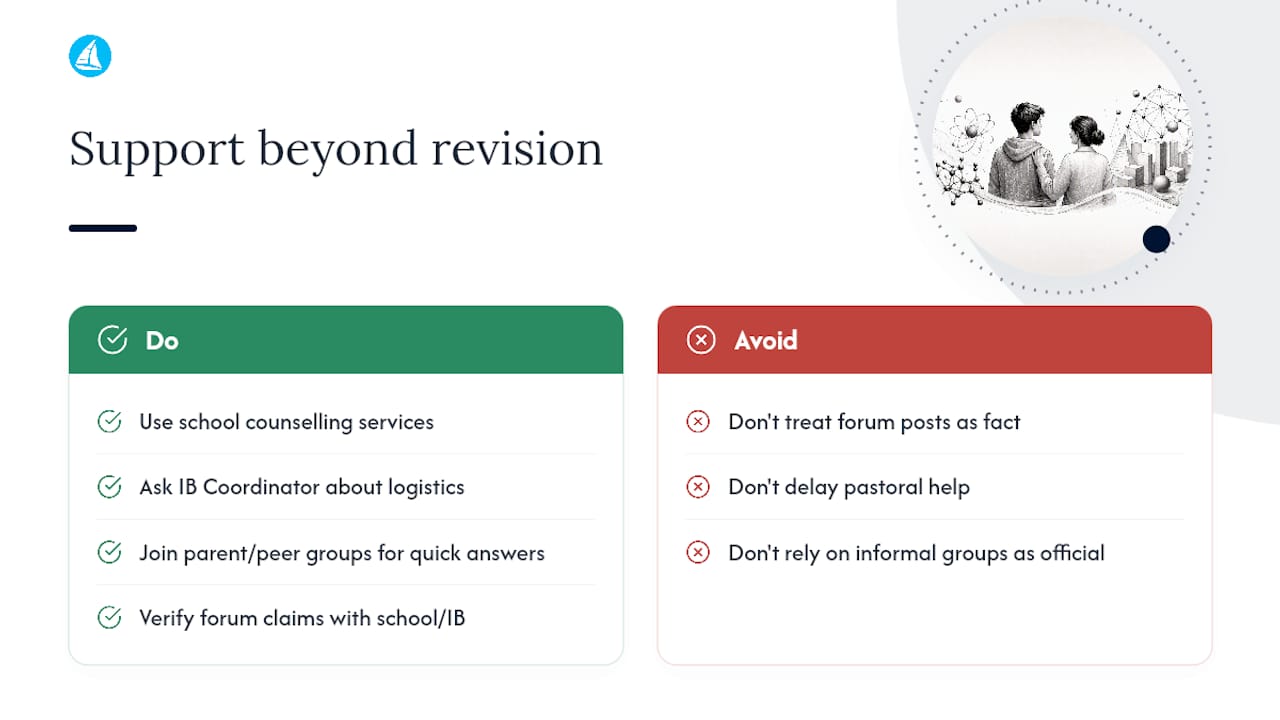
Academic resources solve half the problem. The other half is emotional and organisational support, and most IB schools offer more of it than parents realise. School counselling services exist specifically for exam-related stress, and IB Coordinators are used to fielding logistics questions that feel too small to ask.
Peer and parent networks matter more than they get credit for. Many schools run informal parent groups, sometimes through year-group WhatsApp threads or PTA channels, where practical questions get answered fast: what time the exam hall opens, whether a specific paper had a format change, how other families are handling study leave. These groups will not replace official guidance, but they catch the everyday questions that never make it into a formal FAQ.
Online forums for IB students and parents can be genuinely useful for moral support and shared experience, though the accuracy of exam-specific claims on open forums varies wildly. Treat forum posts as anecdote, not fact, and verify anything specific to rules, dates or grading against the school or the official IB guide.
If your child shows signs of persistent anxiety, sleep disruption or withdrawal beyond ordinary exam nerves, involve the school’s pastoral or counselling team early rather than waiting for it to resolve on its own. Study adjustments for neurodiverse students, including those with ADHD, are worth discussing with the school well before the exam session, since arrangements typically need lead time to be approved. Some families also find structured time-blocking approaches useful for building a sustainable daily routine around revision, especially where a student struggles with self-directed pacing. Where attention or focus concerns are part of the picture, understanding the diagnostic criteria clinicians use for ADHD can help frame a more informed conversation with the school about reasonable adjustments.
A short checklist from Oliver
Confirm your child’s session and exact timetable first. Check every IA and Extended Essay submission has actually been uploaded, not just drafted. Run timed past papers weekly from three months out, and protect sleep over extra revision hours in the final fortnight.
Support without doing the work looks like this: proofread for structure, never rewrite content; manage the calendar, never the calculator settings; ask how revision is going, don’t demand a study log. When anything about logistics or arrangements feels unclear, go straight to the IB Coordinator rather than guessing.
— Oliver
Where Tiber Tutor fits into your family’s final stretch
The platform provides IB Biology, Chemistry, Physics and Maths content, including mock exams and mark schemes that reflect real exam materials. Few other IB science platforms offer such a combination of interlinked notes, flashcards, cram sheets and performance analytics in one place.
For families handling multiple science subjects, an all-access plan covers Biology, Chemistry, Physics and Maths together, including syllabus monitoring and analytics to identify weak topics across subjects. If your child only needs targeted top-up support in one struggling subject, the Per-Subject Plan at $9 per month gives full access to that subject alone, including its mock exams and test builder. Both plans start with a free 7-day trial, giving you time to try a timed mock, review the examiner mark scheme against your child’s answers, and see the analytics dashboard before committing. Compare the full details on the pricing page and take the next step while there is still runway before the exam session.
FAQ
Is the IB actually harder than other qualifications like the A-Levels or AP?
The IB demands breadth that single-subject qualifications do not, since students study six subjects alongside the TOK, Extended Essay and CAS core simultaneously. Difficulty is genuinely subjective and depends on a student’s strengths, but the workload of managing exams and coursework across six subjects at once is a distinct challenge compared to narrower qualifications.
Do universities prefer the IB over other qualifications?
Most universities do not state a blanket preference and instead set entry requirements around specific point totals or subject grades. The diploma’s breadth, including the Extended Essay research component, is often cited by admissions teams as good preparation for independent university study.
What are the hardest IB subjects for most students?
Higher Level Physics, Chemistry, Maths Analysis and Approaches, and Biology consistently rank among the subjects students find most demanding, largely due to content volume and exam technique under time pressure. Genuine difficulty varies by student, which is why examiner-authored science exam guides that target specific weak topics tend to help more than generic revision advice.
Is a score of 26 points a poor outcome?
A score above the minimum threshold generally meets the passing criteria if other conditions on subject grades and core points are also met, so such a score is not automatically a failing result. It sits well below the range most competitive university offers require, so whether it counts as disappointing depends entirely on the student’s specific goals and course applications.
How much does Tiber Tutor cost for parents supporting one subject?
The Per-Subject Plan costs $9 per month and covers full access to one subject, including examiner-authored mocks and a test builder, listed on the pricing page. Families needing coverage across Biology, Chemistry, Physics and Maths together can use the All-Access Plan at $19 per month instead.