Cram sheets for IB students: how to use them for exam gain
Cram sheets are most effective when creating them forces you to select and retrieve, not when you re-read them the night before an exam. The act of condensing a topic onto a single page, deciding what matters and what does not, is itself a form of active recall that strengthens memory. The completed sheet is secondary. What counts is the process of building it, then using it as a prompt to test yourself repeatedly.
The role of cram sheets in exam revision comes down to three specific use-cases:
- Quick retrieval checks: cover the sheet and write down everything you can recall from a topic before comparing against it.
- Procedure and method reminders: a two-column prompt sheet for equation-based problems in IB Chemistry or Physics keeps multi-step methods retrievable under pressure.
- Last-stage revision: short cues for essay plans, key definitions, or worked-example steps in the final days before an IB Biology, Chemistry, or Physics paper.
Used outside these purposes, a cram sheet tends to become a tidy copy of your notes. That is the trap this guide will help you avoid.
Table of Contents
- What is a cram sheet, and which format should you use?
- What cram sheets do well, and the trap to avoid
- How to create a high-impact cram sheet quickly
- How to use cram sheets during revision to build durable recall
- What is allowed in UK and IB exams?
- Revision rules students ask about: 2/3/5:7 and 1-3-7 explained
- How Tibertutor turns cram-sheet practice into measurable IB exam gains
- Key takeaways
- The single change that makes cram sheets worth your time
- Tibertutor: the IB STEM platform built around this workflow
- Useful sources
- FAQ
What is a cram sheet, and which format should you use?
A cram sheet (also called a cheat sheet or revision sheet) is a highly condensed, purpose-driven study aid. Its job is to prompt recall or remind you of a procedure, not to replace structured practice. The format you choose should match the cognitive task you are preparing for.
| Format | Best for | Example use |
|---|---|---|
| Flashcard-style Q&A cards | Spaced recall of definitions, equations, and processes | IB Biology: “What is the role of ATP synthase?” on one side; answer on the other |
| Method/procedure sheet | Applied maths and sciences with multi-step problems | IB Chemistry: prompt → first step → common trap for equilibrium calculations |
| One-page topic summary | Linking concepts across a topic before a mock exam | IB Physics: key equations, units, and one worked-example cue per topic |
| Formula reference sheet | Quick look-up during permitted open-note practice | IB Maths: formula list with annotated conditions for each expression |
Flashcards suit spaced recall because you can shuffle and test yourself on individual items. Method sheets work best for IB Chemistry and Physics, where a procedural misstep costs marks. One-page summaries help you see how a topic fits together before a mock, though they carry the highest risk of becoming too dense to use.
What cram sheets do well, and the trap to avoid
The genuine benefits of cram sheets are specific. They force you to select what matters, which is a form of prioritisation that passive re-reading never demands. They clarify structure, making relationships between ideas visible on a single page. They speed targeted revision in the final week, and they support last-stage recall checks when you already understand the material.
The problem arises when a sheet becomes a near-complete copy of your notes. Research on student support sheets shows that excessive density correlates with lower exam performance. Annotated procedures that guide application outperform lists of isolated facts. A packed sheet is harder to scan under pressure, and it gives you a false sense of mastery because you feel prepared without having retrieved anything.
The cram-sheet trap: the moment you mistake tidy condensation for durable learning. A well-organised sheet that you have never tested yourself against is not revision. It is decoration.
Experimental evidence suggests that student-prepared crib sheets can improve test performance when used properly. The key word is properly. Sheets help when they force selection and immediate retrieval; they waste time when they become a substitute for practice.
Cram sheets are supplements, not primary study materials. Foundational learning must come from structured practice and authoritative sources first. The sheet comes later, as a retrieval scaffold.

Pro Tip: Set a strict time limit when making any cram sheet to avoid copying instead of selecting.
How to create a high-impact cram sheet quickly
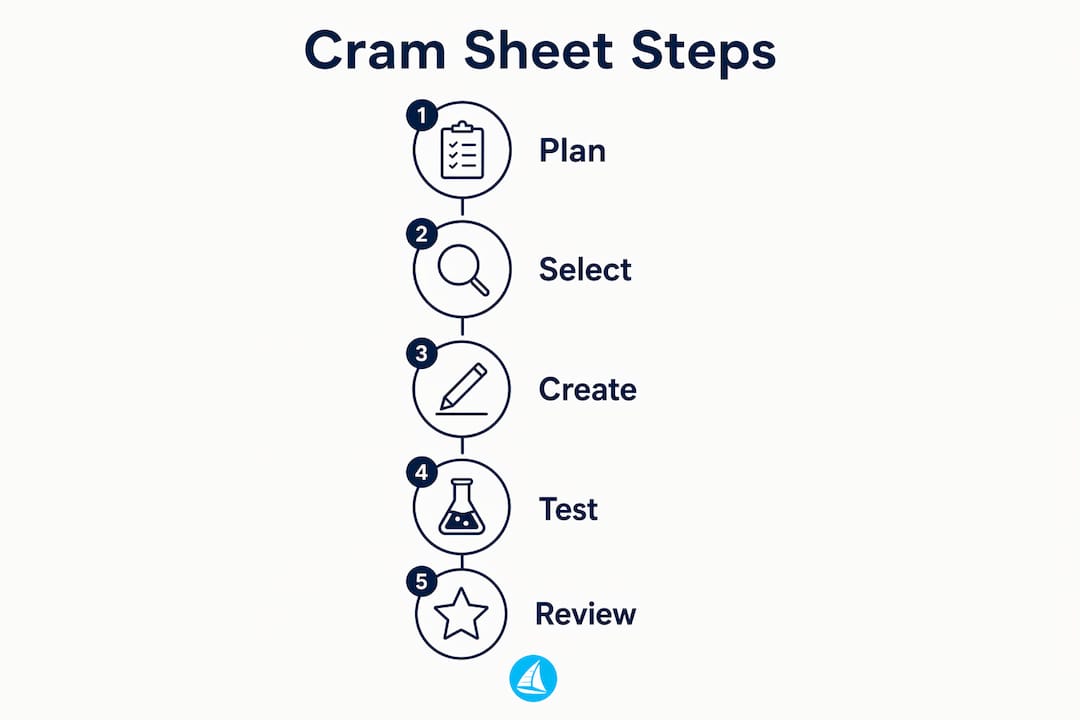
A well-made cram sheet takes a limited amount of time; if it takes longer, it is too detailed. Follow this sequence:
- Identify your six to ten weakest items. Pull these from past-paper mark schemes or a recent topic test. Do not start from your notes; start from where marks were lost.
- Apply the one-idea-per-cue rule. Each card, box, or row holds a single concept, equation, or procedure step. No paragraphs. No full sentences unless a definition requires it.
- Prefer prompts that force production. Write a question or a partial diagram rather than a completed answer. “Draw the electron transport chain” beats a labelled diagram you can just stare at.
- Annotate equations with procedural cues. For IB Chemistry and Physics, note the first step and the most common mistake beside each formula. Practitioners find that annotating equations with procedural cues and common traps supports application far more than listing raw definitions.
- Add a past-paper reference. Beside each cue, note one past-paper question number that tests it. This converts the sheet into a practice launchpad rather than a passive reference.
- Keep the layout visual and sparse. Use two columns, clear boxes, and white space. A sheet you can scan in ten seconds under exam pressure is more useful than one that requires careful reading.
Mini worked example for a method sheet (IB Chemistry equilibrium):
| Prompt | First step | Common trap |
|---|---|---|
| Write the expression for Kc | Identify products over reactants | Forgetting to exclude pure solids and liquids |
That is the entire entry. One row, three cells, ready to test yourself against.
How to use cram sheets during revision to build durable recall
Making the sheet is only the start. The revision value comes from how you use it afterwards.
The most direct approach is to close your notes, look at the prompt side of the sheet, and write or say the answer aloud before checking. This is retrieval practice, and meta-analytic evidence consistently shows that practice testing produces stronger learning outcomes than passive re-reading. Familiarity feels like knowledge until the exam asks you to produce, not recognise.
Space your returns to the sheet. After your first retrieval session, return the next day, then three days later, then a week later. This spacing effect is one of the most replicated findings in memory research. A single long session the night before distributes everything into short-term memory, which decays quickly. The same time spread across several sessions produces significantly stronger retention.
Once you can retrieve a cue reliably, convert it into an exam-style task. Pick the prompt, then answer a timed past-paper question on that topic without looking at the sheet. Tibertutor’s IB exam-style question workflow explains exactly how to structure this kind of timed conversion practice. The IB question bank supports repeated, syllabus-aligned testing that maps directly to short-card prompts, so you can track whether retrieval is actually improving.
Pair your sheet work with mock exam cycles. A mock exam before you make a sheet tells you what to put on it. A mock exam after tells you whether it worked.
What is allowed in UK and IB exams?
This matters more than most students realise. The rules differ by exam board, subject, and paper, and getting it wrong has serious consequences.
IB exam conduct rules:
- The International Baccalaureate Organisation (IBO) does not permit unauthorised notes, crib sheets, or personal reference materials in standard examinations.
- Some IB subjects provide an official data booklet or formula sheet (for example, IB Chemistry and IB Physics). These are issued by the exam centre and are the only permitted reference materials.
- Any annotations on permitted materials that were not placed there by the exam centre are considered unauthorised.
- Bringing a personal cram sheet into an IB exam is a breach of academic integrity and can result in a grade penalty or disqualification.
UK GCSE and A-Level rules:
- Awarding bodies such as AQA, OCR, and Edexcel do not permit personal notes or cram sheets in standard closed-book exams.
- Some coursework or controlled assessment tasks may allow reference materials; check the specific task instructions.
Academic integrity is non-negotiable. Cram sheets are revision tools, not exam aids. Using one in an exam without explicit permission from the exam board is misconduct, regardless of intent. The consequences under IBO regulations and UK awarding body rules can include mark cancellation and a formal record of malpractice.
Day-of-exam compliance checklist:
- Confirm with your teacher or exam officer which materials are officially permitted for your specific paper.
- Remove any personal annotations from permitted data booklets before entering the exam room.
- Leave all personal cram sheets, flashcards, and revision notes outside the exam room.
- If in doubt, ask. No mark is worth the risk.
Revision rules students ask about: 2/3/5:7 and 1-3-7 explained
Two revision formulas appear frequently in student searches. Here is what they mean and how they fit with cram-sheet use.
The 2357 method (sometimes written 2/3/5:7) is a spaced repetition schedule. After first learning a topic, you review it after 2 days, then 3 days later, then 5 days later, then 7 days later. Birmingham City University recommends this method as a practical way to plan a revision timetable. Each review session is where your cram sheet becomes useful: use it as a prompt, attempt retrieval, then check.
The 1-3-7 rule follows a similar logic: review after 1 day, 3 days, and 7 days. Both formulas encode the same principle. Reviewing material you have partially forgotten strengthens the memory more than reviewing it immediately.
| Rule | Review points | Cram-sheet role | Session length |
|---|---|---|---|
| 2357 method | Day 2, 5, 8 | Retrieval prompt at each return | 25 minutes focused, 5-minute break |
| 1-3-7 rule | Day 1, 4, 11 | Cover-and-recall check, then past-paper task | 25 minutes focused, 5-minute break |
| Daily session cap | Per session | One sheet topic per Pomodoro block | 25 minutes active, 5 minutes rest |
For IB science students, a practical fortnight schedule looks like this: make a sheet on a weak topic on Day 1, do a retrieval check on Day 2, attempt a past-paper question on Day 4, run a short mock on Day 8, and review errors on Day 11. That is three spaced returns with increasing difficulty, which is the minimum for solid retention before an exam.
Working smarter rather than longer is the consistent finding across revision research. A focused 25-minute retrieval session on your three weakest topics covers more ground than a two-hour re-reading session.
How Tibertutor turns cram-sheet practice into measurable IB exam gains
Tibertutor is built specifically for IB Biology, Chemistry, Physics, and Maths students, and every resource on the platform is authored by practising IB examiners. That matters because examiner-authored content reflects exactly how mark schemes differentiate recall from understanding, which is the gap a well-used cram sheet should help you close.
The platform’s resources integrate directly with the cram-sheet workflow described in this guide:
- Examiner-authored cram sheets for IB Chemistry and other sciences, structured around syllabus checkpoints and common exam errors, not generic topic summaries.
- Exam-style question banks for IB Biology, Chemistry, and Physics that let you convert a single sheet prompt into a timed practice question, then check your answer against an examiner mark scheme.
- Mock exams with analytics that show pre- and post-sheet performance by topic, so you can see whether your retrieval is actually improving rather than guessing.
- Progress tracking and performance insights that are not available on any other IB platform, giving you a precise picture of which topics need another retrieval cycle and which are secure.
- Syllabus monitoring that flags when a topic has been covered and links it to the relevant question bank items, keeping your sheet work aligned to what the exam actually tests.
The interlinked nature of Tibertutor’s resources is what sets it apart. A cram-sheet cue connects to a question bank item, which connects to a mock exam, which connects to analytics showing your improvement. No other IB STEM platform offers that depth of integration at this level of examiner quality.
Pro Tip: Run a Tibertutor topic test before you make a cram sheet on that topic. Your score tells you exactly which six to ten items belong on the sheet, so you are not guessing at your own gaps.
Key takeaways
Cram sheets work when they force selection and retrieval practice; they fail when they become dense copies of notes that you re-read passively.
| Point | Details |
|---|---|
| Time-cap creation | Spend 20–30 minutes maximum making any cram sheet; longer means copying, not selecting. |
| One idea per cue | Each entry holds a single concept, equation, or procedure step to keep the sheet usable under pressure. |
| Immediate retrieval | Cover the sheet and attempt recall aloud or in writing before checking; this is where the learning happens. |
| Spaced returns | Return to the sheet after 1 day, 3 days, and 7 days (1-3-7 rule) to build durable memory. |
| Tibertutor integration | Use Tibertutor’s examiner-authored question banks and mock exams to convert sheet cues into measurable practice. |
The single change that makes cram sheets worth your time
Most students who struggle with cram sheets are making the same mistake: they spend an hour producing a beautiful, colour-coded page and then re-read it twice before the exam. That is not revision. That is note-taking with extra steps.
The research is clear. Retrieval strength predicts exam gains more reliably than note volume. Examiners can tell the difference between a student who has memorised a summary and one who has practised applying knowledge under exam conditions. Mark schemes reward the second student. A cram sheet that you have tested yourself against repeatedly, linked to past-paper questions, and returned to across a fortnight is a genuinely useful revision tool. One that you have only read is not.
The single change: stop making sheets and start testing with them. Build the sheet in 20 minutes, then spend the rest of your session attempting retrieval. If you cannot recall a cue, that is the gap to work on, not a reason to rewrite the sheet more neatly.
Tibertutor: the IB STEM platform built around this workflow
For IB Biology, Chemistry, and Physics students who want their cram-sheet work to translate into real exam gains, Tibertutor offers the most complete and examiner-aligned set of resources available online.

Every cram sheet, question bank item, and mock exam on Tibertutor is written by practising IB examiners, which means the content reflects exactly what the mark scheme rewards. The platform’s IB Biology exam tests and IB Chemistry exam tests let you convert a single sheet prompt into a timed, curriculum-aligned practice question within minutes. The analytics then show you whether your retrieval is improving across sessions, something no other IB platform provides at this level of detail.
A free 7-day trial gives you full access to the question banks, cram sheets, mock exams, and progress tracking. Start with a topic test to identify your gaps, build a focused sheet, then use the question bank to test whether the sheet is working. Visit Tibertutor pricing to see the subscription options and begin your trial.
Useful sources
- Birmingham City University: how to revise effectively — practical guidance on spaced repetition and the 2357 method for revision planning.
- Implications of crib sheets for student well-being and exam performance — peer-reviewed mixed-methods study on crib sheet content, layout, and exam performance in UK undergraduate students.
- Student perspectives on the utility of crib sheets for learning — research on how students learn during crib sheet construction; supports the coding hypothesis over the dependency hypothesis.
- Do support sheets actually support students? — content analysis showing that annotated procedural cues outperform dense fact lists on exam support sheets.
- Do crib sheets improve student performance on tests? — experimental evidence that student-prepared crib sheets can improve test performance when used appropriately.
- Revision sheets: when they help and when they waste time — practical guidance on the cram-sheet trap and timed creation limits.
- How to revise effectively: evidence-based techniques — summary of retrieval strength research and how exam-style practice converts sheet cues into measurable gains.
- Study techniques for exams: ranked by what actually works — ranked analysis of study techniques including practice testing and distributed practice.
- IB Chemistry cram sheets: Tibertutor — examiner-authored cram sheets for IB Chemistry, aligned to the current syllabus.
- Why mock exams improve performance: IB guide: Tibertutor — guidance on mock exam cycles, error analysis, and targeted improvement for IB students.
On checking permitted materials: IB exam rules are set by the International Baccalaureate Organisation and updated each examination session. Always confirm which materials are permitted for your specific paper with your teacher or exam officer before the day of the exam. Do not rely on general guidance alone.
This article is general educational information, not professional academic or legal advice. Confirm current IB and UK exam board rules with your school or the relevant awarding body for your own situation.
FAQ
What is the 2357 method for revision?
The 2357 method is a spaced repetition schedule where you review a topic after 2 days, then 3 days later, then 5 days later, then 7 days later. Each return session is an opportunity to use your cram sheet as a retrieval prompt rather than re-reading your notes.
What is the 1-3-7 rule for revision?
The 1-3-7 rule means reviewing a topic 1 day, 3 days, and 7 days after first studying it. Both the 1-3-7 and 2357 methods encode the spacing effect: reviewing partially forgotten material strengthens memory more than immediate review.
How do you cram revise effectively?
Effective cramming means using your remaining time on retrieval practice, not re-reading. Build a focused cram sheet in 20–30 minutes covering your six to ten weakest items, then spend the rest of your session testing yourself against it using past-paper questions.
Is 2 hours of revision a day enough for GCSE or IB?
Two hours of focused, retrieval-based revision per day is more productive than longer sessions of passive re-reading. Quality matters more than quantity: two hours of active recall and past-paper practice, structured around spaced returns, will outperform five hours of highlighting and re-reading.
Can Tibertutor help me check whether my cram sheet is working?
Yes. Run a Tibertutor topic test before and after building a cram sheet on a weak area. The platform’s analytics show your retrieval accuracy by topic across sessions, giving you a clear, data-backed picture of whether the sheet is improving your performance.