IB university recognition: what it means for UK applicants
UK universities formally recognise the International Baccalaureate (IB) Diploma Programme as a qualification for undergraduate admissions, and many publish specific recognition statements covering offer conditions, Higher Level (HL) subject requirements, and, in some cases, credit or advanced standing. The IBO Recognition Statements Database is the primary place to check how any institution treats IB results, alongside UCAS guidance and individual university admissions pages.
IB university recognition typically covers three distinct outcomes:
- Admissions offers: a conditional offer specifying a total IB points threshold plus any required HL subjects and minimum grades
- Credit or advanced standing: exemption from specific first-year modules based on HL subject performance
- Scholarships and recruitment: some universities actively recruit IB students and offer merit-based awards linked to IB results
Pro Tip: Check the IBO Recognition Statements Database before finalising your subject choices in Year 1 of the Diploma, not after. HL decisions made early directly affect which offers you can realistically meet.
Key takeaways
IB university recognition in the UK covers admissions offers, credit or advanced standing, and scholarships, and each institution sets its own criteria, so checking the IBO Recognition Statements Database early is the single most important practical step.
| Point | Details |
|---|---|
| Check the IBO database first | The Recognition Statements Database lists offer conditions, HL requirements, and credit policies for universities worldwide. |
| Recognition is not a guaranteed offer | Each university sets its own thresholds; meeting general IB recognition does not secure a place. |
| A large number of universities worldwide receive IB transcripts | This global reach confirms the Diploma’s standing, but UK credit policies vary by institution and course. |
| HL subject choices are decisive for STEM | Choosing HL Maths and at least one HL science is the baseline expectation for competitive UK STEM courses. |
| Tibertutor closes the HL preparation gap | Examiner-created resources and granular analytics help students meet the specific HL scores that UK offers require. |
Table of Contents
- What does IB university recognition actually mean?
- How do UK universities use IB results in admissions?
- Does the IB give you university credit in the UK?
- Where can you check whether a UK university recognises the IB?
- Full IB Diploma versus individual DP courses: what universities prefer
- Evidence-based tips for strengthening your UK STEM application
- How admissions officers read IB STEM applications
- Tibertutor: focused IB STEM preparation for UK applicants
- Sources
- FAQ
What does IB university recognition actually mean?
Recognition is not a single thing. When a university says it “recognises” the IB, it may mean any combination of the following: it accepts IB results as a basis for an admissions offer, it awards credit or advanced standing for strong HL performance, it actively recruits IB students, or it publishes a formal recognition statement setting out its policies. Understanding which of these applies to your target institution is the practical work recognition requires.
The distinction between acceptance and recognition matters. Acceptance means the university will consider an IB application. Recognition goes further: it means the institution has published criteria specific to the IB, often including required programmes, minimum grades, and sometimes credit policies. As the IBO makes clear, recognition is not a guarantee of admission. Each university sets its own thresholds, and meeting the IB’s general recognition does not automatically secure a place.
The IBO Recognition Statements Database lists universities that have published these criteria. Entries typically show:
- Which IB programmes the university accepts (most commonly the Diploma Programme)
- Minimum total points and any HL subject requirements
- Whether credit or advanced standing is available, and under what conditions
- Any scholarship or recruitment policies linked to IB results
For a fuller picture of what the IB programme involves and how it is structured, the International Baccalaureate Programme overview is a useful starting point.
How do UK universities use IB results in admissions?
Admissions offers at UK universities almost always specify a total IB points score alongside HL subject conditions. A competitive science or engineering course might ask for 38 points overall with 6, 6, 6 at HL, including HL Mathematics and HL Physics or Chemistry. The total points figure and the HL conditions are both binding: meeting one but not the other means the offer is not fulfilled.

UCAS maps IB points to its own tariff, which allows universities to compare IB applicants with those holding A-levels. Understanding what an IB score means in this context helps you see how your predicted grades translate into UCAS points and how they compare with A-level equivalents. A score of 38 IB points, for example, sits broadly in the range of three A grades at A-level, though the exact mapping depends on HL grades and the UCAS tariff applied.
| Recognition type | Typical IB offer shape | HL subject conditions | Notes |
|---|---|---|---|
| Admissions offer | a high points score | HL Maths + one HL science at a strong grade | Competitive STEM course |
| Admissions offer | 40 points | HL Maths + HL Biology/Chemistry at 6–7 | Selective STEM course (medicine) |
| Credit/advanced standing | Score-dependent | HL subject at 6 or 7 | Module-specific; confirm in writing |
| Scholarship | High overall score | Strong HL profile | Varies by institution |
Pro Tip: If you are applying to competitive STEM courses, choosing HL Mathematics Analysis and Approaches alongside HL Physics or HL Chemistry is not optional — it is the baseline expectation at most selective UK universities as discussed in Science - An ignored middle child?. Confirm the specific HL requirements on the university’s admissions page before finalising your subject choices.*
Does the IB give you university credit in the UK?
Some UK universities award credit or advanced standing for strong HL subject performance, but this is less common and less standardised than in North America. Where it does exist, it is almost always tied to specific module exemptions rather than general credit hours. A student who scores 7 in HL Chemistry, for instance, might be exempt from a first-year analytical chemistry module, but the university will specify exactly which module is waived. Requesting written confirmation of this is worth doing before you enrol.
Typical conditions for credit or advanced standing in the UK include:
- A minimum HL grade of 6 or 7 in the relevant subject
- Clear syllabus overlap between the HL course and the first-year module in question
- A formal application to the department, sometimes with a copy of the IB syllabus
- Departmental approval on a case-by-case basis
The scale of IB recognition globally gives useful context here. Over 4,500 universities in more than 110 countries receive IB students’ transcripts each year, and many of those institutions publish formal credit policies. In the UK, the picture is more variable: credit is available at some institutions and not others, and policies differ even between departments within the same university.
The US model, where credit for HL subjects is widespread and often automatic above a certain score, does not translate directly to UK higher education. UK universities tend to treat credit as an exception rather than a default. Always check the specific policy rather than assuming it applies.
Where can you check whether a UK university recognises the IB?
Start with the IBO Recognition Statements Database. It is the most comprehensive single source, and it is where universities publish their official criteria. From there, move to the university’s own admissions pages and UCAS subject pages to confirm the details.
Here is a practical sequence to follow:
- Search the IBO database using the country and institution filters. Look for the university’s recognition statement, which will show accepted programmes, minimum points, HL requirements, and any credit policies.
- Read the recognition statement carefully. Note the total points required, any specific HL subjects and minimum grades, and whether credit or advanced standing is mentioned.
- Check the university’s own admissions page for the specific course you are applying to. Offer conditions listed there take precedence over anything in the database if there is a discrepancy.
- Consult UCAS subject pages for the course. UCAS guidance often includes IB-specific entry requirements alongside A-level equivalents.
- Contact the admissions team directly if anything is unclear or if the university does not appear in the database.
One important caveat: the database is not exhaustive. If a university is not listed, that does not mean it does not accept IB students. The University Portal, launched in 2023, allows universities to create and update their own recognition statements, but not every institution has done so. Statements may also become outdated between updates, so direct verification with the university remains the safest step.
When contacting admissions, prepare the following:
- Your predicted grades (total and HL breakdown)
- The IB syllabus for any subject you are seeking credit for
- Your IB transcript (or a summary of results if applying pre-results)
Full IB Diploma versus individual DP courses: what universities prefer
Most UK universities prefer applicants holding the full IB Diploma over those presenting individual DP courses or certificates. The Diploma signals a complete, rigorous qualification, and admissions teams are familiar with how to assess it. Individual DP courses are increasingly accepted, but the policies vary considerably.
Key differences in how universities treat each:
- Full Diploma: widely accepted for admissions offers; eligible for credit/advanced standing where policies exist; sometimes linked to scholarship opportunities; the standard expectation for competitive courses
- Individual DP courses or certificates: accepted by a growing number of institutions, particularly for credit purposes, but rarely treated as equivalent to the full Diploma for competitive admissions; recognition for individual courses is more common in the US than in the UK
- Scholarship eligibility: most IB-linked scholarships require the full Diploma, not individual courses
If you are taking individual DP courses rather than the full Diploma, check each target university’s policy explicitly. Some will accept individual courses for credit in a way similar to how they treat honours or advanced placement classes, but this is not universal. Present your results clearly in your application and be prepared to explain your programme structure to admissions teams who may be less familiar with it.
Evidence-based tips for strengthening your UK STEM application
Focused HL choices, syllabus alignment, and demonstrable practical skills materially improve your prospects for both admissions offers and credit decisions. The IB’s collaboration with universities to align DP curricula with undergraduate modules means that universities increasingly assess whether an applicant’s IB syllabus covers first-year content — and admissions officers sometimes use internal course-mapping to make that judgement.
Steps that make a measurable difference for STEM applicants:
- Choose HL Mathematics and at least one HL science relevant to your intended degree. HL Mathematics Analysis and Approaches is the preferred choice for most STEM courses; HL Applications and Interpretation may not satisfy requirements for selective engineering or physics programmes.
- Use syllabus-aligned mock exams to practise under exam conditions. The gap between classroom understanding and exam performance is where offers are won or lost, particularly for HL Biology and HL Chemistry, where the difficulty of the exam format catches many students off guard.
- Prepare an Extended Essay with STEM relevance where possible. A well-executed science EE demonstrates research skills and subject depth that admissions teams notice.
- Secure teacher references that speak to practical lab skills. For medicine, biochemistry, and engineering, evidence of hands-on scientific work strengthens an application considerably.
- Align your personal statement to show how your HL subjects connect to first-year module content at your target university. This is the kind of syllabus awareness that admissions teams are looking for.
Pro Tip: Granular progress analytics, like those available on Tibertutor, let you identify exactly which HL topic areas are dragging your score down. Closing a gap in HL Chemistry Paper 3, for example, can be the difference between a 5 and a 6 — and that single grade point can determine whether a conditional offer is met.
How admissions officers read IB STEM applications
What stands out to an admissions officer reading an IB STEM application is not the total points figure in isolation. It is the combination of HL subject choice, predicted grades in those subjects, and evidence that the applicant understands what the first year of their chosen degree actually involves.
Predicted grades carry significant weight in the UK system, where most offers are made before final results. An applicant predicted 40 points with 7, 7, 6 at HL in Mathematics, Chemistry, and Physics is a different proposition from one predicted 40 points with lower HL grades in less relevant subjects. Admissions teams read the HL breakdown carefully, and a strong total built on weaker HL subjects in STEM courses will not compensate for missing the HL conditions.
Personal statements are read for evidence of subject engagement beyond the classroom. For STEM applicants, this means referencing specific topics from the HL syllabus, connecting them to the degree subject, and demonstrating curiosity that goes beyond what the course requires. Internal assessments, particularly in sciences, can be referenced to show practical competence. A well-executed IA in HL Chemistry or HL Biology tells an admissions officer something a grade alone cannot.

The single most common pitfall is treating the IB as a points game without attending to the HL conditions. Meeting the total but missing a required HL grade is the most frequent reason a conditional offer is not confirmed. Check the HL requirements for every course you apply to, and build your preparation around meeting them specifically.
Tibertutor: focused IB STEM preparation for UK applicants
Tibertutor gives IB science and maths students the most thorough, examiner-led preparation available online, built specifically to meet the HL standards that UK universities expect.
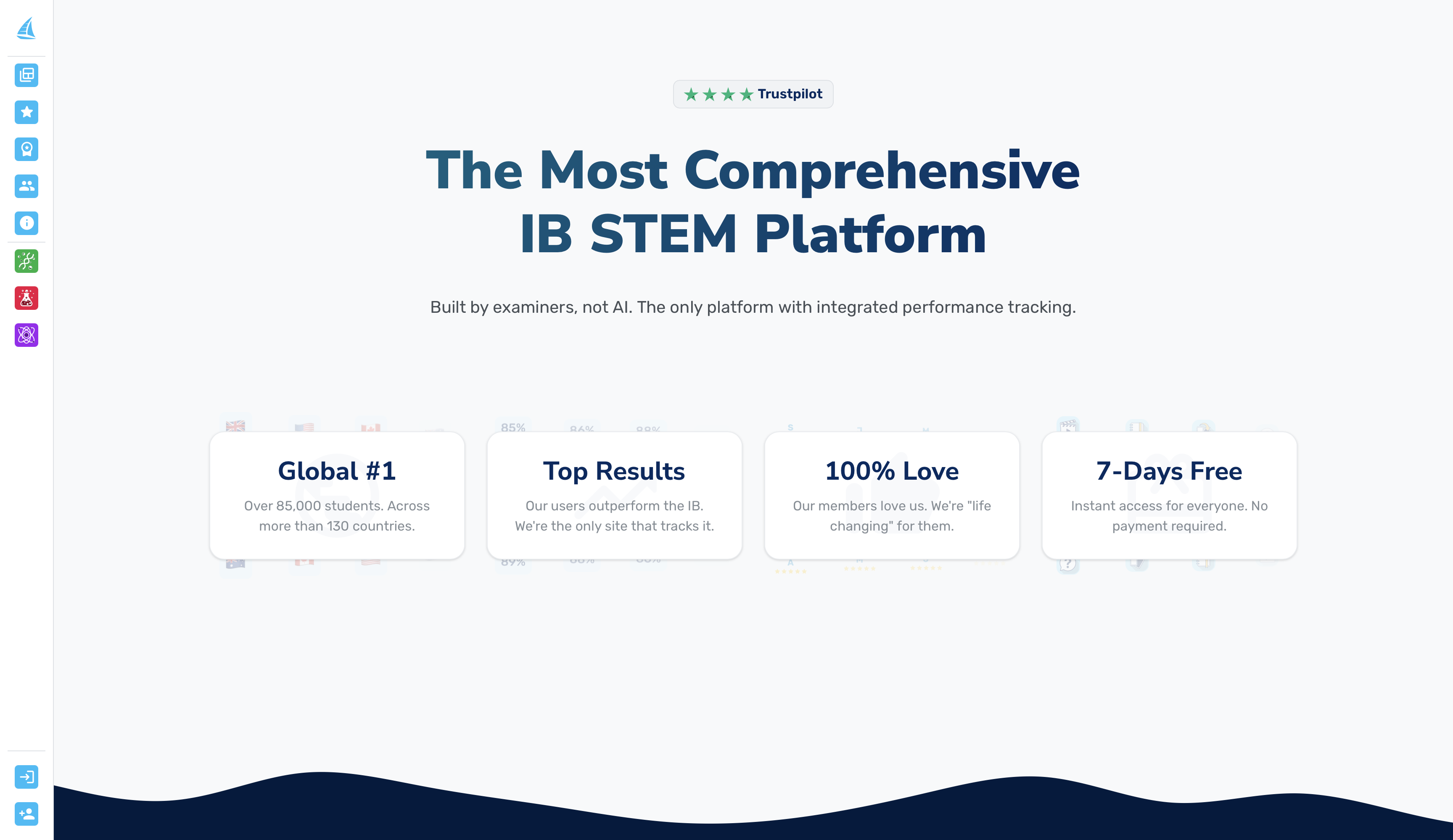
Every resource on the platform is created by actual IB examiners, which means the question styles, mark schemes, and feedback reflect exactly what appears in real exams. The IB Biology topic tests, IB Chemistry practice tests, and IB Chemistry mock exams are all syllabus-aligned and updated to match current specifications. Animated instructional videos, IA exemplars, flashcards, and cram sheets are woven together with a custom test builder and advanced performance analytics that show you precisely where your marks are being lost. No other IB platform offers this level of integration between practice resources and progress insight.
For UK applicants working towards competitive STEM offers, Tibertutor’s analytics are particularly valuable: they track performance by topic and question type, giving you and your teachers a clear picture of which HL areas need more work before predicted grades are submitted. Start with a free 7-day trial and see how the platform fits your preparation.
Sources
Before finalising any recognition or credit assumption, go directly to the primary sources:
- Find countries and universities that admit IB students - International Baccalaureate®
FAQ
Do UK universities recognise the IB Diploma?
Yes. UK universities widely accept the IB Diploma for undergraduate admissions and publish specific offer conditions, including total points thresholds and HL subject requirements. Recognition policies vary by institution and course, so always check the university’s admissions page directly.
Is the IB equivalent to A-levels for UCAS purposes?
The IB maps to the UCAS tariff, allowing universities to compare IB and A-level applicants. A strong IB score with good HL grades is broadly comparable to three A-level grades, though the exact equivalence depends on the UCAS tariff applied and the specific HL results.
Do UK universities give credit for IB Higher Level subjects?
Some do, but it is less common and less standardised than in North America. Where credit exists, it is usually tied to specific module exemptions rather than general credit, and a minimum HL grade of 6 or 7 is typically required. Always request written confirmation of which modules would be waived.
Does the full IB Diploma carry more weight than individual DP courses?
Yes, for most UK universities. The full Diploma is the standard expectation for competitive admissions, and most IB-linked scholarships require it. Individual DP courses are increasingly accepted for credit purposes, but they are rarely treated as equivalent to the full Diploma for selective course entry.
How can Tibertutor help with meeting HL requirements?
Tibertutor’s examiner-created topic tests, mock exams, and performance analytics are built to match the exact demands of HL Biology, Chemistry, Physics, and Maths exams. The platform’s progress tracking identifies specific topic gaps, helping students target the HL scores that UK university offers require.