A Level vs IB: Which Route Suits You in 2026?
The IB Diploma is broad: six subjects plus a core, studied over two years. A levels are deep: usually three or four subjects studied in more detail. Neither is simply harder. If you are aiming at US universities, the IB is generally the easier qualification for admissions officers to read, while A levels suit students who already know exactly what they want to study.
This guide compares the two on structure, assessment, workload and US recognition. It also shows what a science-focused IB student can do to prepare with confidence.
TL;DR
- The IB Diploma means six subjects plus the core (TOK, CAS and the extended essay). A levels usually mean three or four subjects.
- A levels go deeper per subject. The IB goes wider and asks for steady work across many deadlines.
- Both are mostly judged by end-of-course exams, with different grading scales: A* to E for A levels, 1 to 7 per subject for the IB.
- For US applicants, many selective universities give credit for IB Higher Level scores, so check each policy.
- If you choose the IB sciences, exam-style practice and progress tracking make the workload manageable.
Table of Contents
- How the two qualifications are built
- Assessment and grading
- Is the IB harder than A levels?
- What this means for US universities
- How to choose
- Our perspective
- Prepare for the IB sciences with Tiber Tutor
- FAQ
- Sources
How the two qualifications are built
The IB Diploma Programme curriculum is made up of six subject groups and the DP core. The core has three parts: theory of knowledge (TOK), creativity, activity, service (CAS) and the extended essay. You study across sciences, maths, languages and the arts or humanities, and you take at least some courses at Higher Level (HL) and the rest at Standard Level (SL).
A levels work differently. A UK government comparison of the two routes describes the IB as a broad curriculum of six subjects with TOK, CAS and an extended essay on top. A levels, by contrast, let you narrow quickly. A student heading for medicine might take Biology, Chemistry and Maths and stop there. Cambridge International describes A levels as typically a two-year course, with AS typically one year.

If you want to see how the IB sciences fit together, our guide to IB Biology, Chemistry and Physics courses walks through each one.
Assessment and grading
Both routes lean on final exams. For most IB courses, written examinations at the end of the programme form the basis of assessment, and the IB also uses internally assessed components such as the science Internal Assessment. A-level exams are primarily taken at the end of the second year, although some students sit early papers that do not count towards the final grade.
The grading scales differ:
| A levels | IB Diploma | |
|---|---|---|
| Subjects | Usually 3 or 4 | 6, plus the core |
| Grading | A* to E per subject | 1 to 7 per subject, plus core points |
| Main assessment | Exams at the end of the course | Exams at the end, plus internal assessment |
| Style | Depth in few subjects | Breadth across groups |
A UK government report found general consistency between the scales: an A was comparable to 7 IB points and an E to 4 points. That report dates from 2003, so treat it as a rough guide to how the two compare, not a current conversion table.
Practical work is one place the routes diverge. In IB sciences, lab work feeds into an internally assessed component. Our guides to IB internal assessment and the types of science IA explain how it is marked, and the IB assessment criteria guide shows what examiners reward.
Maths is another place where students notice the difference, because the two routes build on earlier study in different ways. Solid groundwork, such as IGCSE-aligned maths content, helps before you start either course. If you pick the IB, choosing between Maths AA and AI matters for university requirements.
Is the IB harder than A levels?
Honestly, it depends on you. Nord Anglia’s comparison says there is no single harder option for everyone: the IB asks you to manage six subjects and the core across two years, while A levels ask you to go deeper in fewer subjects. The pressure is different in kind.
In practice that looks like this:
- IB: a wide, continuous load. Internal assessments, the extended essay, TOK and CAS all run alongside your subjects.
- A levels: a deep, concentrated load, with the pressure building toward the final exams.
Students who like variety and can juggle deadlines often thrive on the IB. Students who dislike a subject they would have to keep studying may find the A-level route more comfortable. Neither choice is a shortcut.
What this means for US universities
If you are applying to US colleges, the IB tends to be the more familiar qualification. A levels are widely understood too, but US admissions offices typically evaluate an international applicant’s record in the context of their educational environment, not against a US curriculum.
Credit policies are where the IB often pays off, and Higher Level matters:
- Georgetown awards IB credit only for Higher Level exams, none for Standard Level, and asks you to release scores to the university in the summer before enrolment.
- Northeastern accepts scores of 5, 6 or 7 on Higher Level exams only.
- At NYU Stern, advanced standing can follow Higher Level grades of 6 or 7, with none for Standard Level.
Policies change each year, so always check the current page of each college you are applying to. Our guide to IB university recognition covers the wider picture, and the Biology HL vs SL comparison helps you decide which sciences to take at Higher Level.
How to choose
Ask yourself four questions:
- Do I know what I want to study? A clear plan, such as engineering or medicine, points towards A levels. Keeping options open points towards the IB.
- Do I enjoy working across many subjects? If yes, the IB’s breadth is a strength.
- Where do I want to study? For US colleges, the IB is usually the smoother path, particularly with strong Higher Level scores.
- How do I handle long projects? The IB’s extended essay, IAs and CAS reward steady planning.
Nord Anglia frames it similarly: the IB suits students who enjoy a range of subjects or want to keep options open, and A levels suit those who know what they want to go deep on.
Our perspective
If you choose the IB, the sciences are where preparation pays off most. Biology, Chemistry, Physics and Maths reward students who practise in the style of the real exam and who can see exactly where their marks are slipping.
That is why we built Tiber Tutor the way we did. Our resources are written by actual IB examiners, and they are connected to one another: exam-style questions link to notes, animated videos, flashcards, cram sheets, topic tests and mock exams. Student-led answer review lets you mark your own work against examiner mark schemes. Progress tracking and performance analytics then show which syllabus areas need attention.
We believe this combination of examiner-written content, polished materials and integrated analytics gives IB science students the highest quality and breadth of resources online, and we are not aware of another IB STEM platform that offers it all in one place. For the price, we think it is the best value on offer, because every resource is made by people who know how the exams are marked.
Oliver
Prepare for the IB sciences with Tiber Tutor
Students who choose the IB can start with a free 7-day trial, then pick the plan that fits. The Per-Subject Plan is $9 per month. The All-Access Plan is $19 per month. Both are on our pricing page.
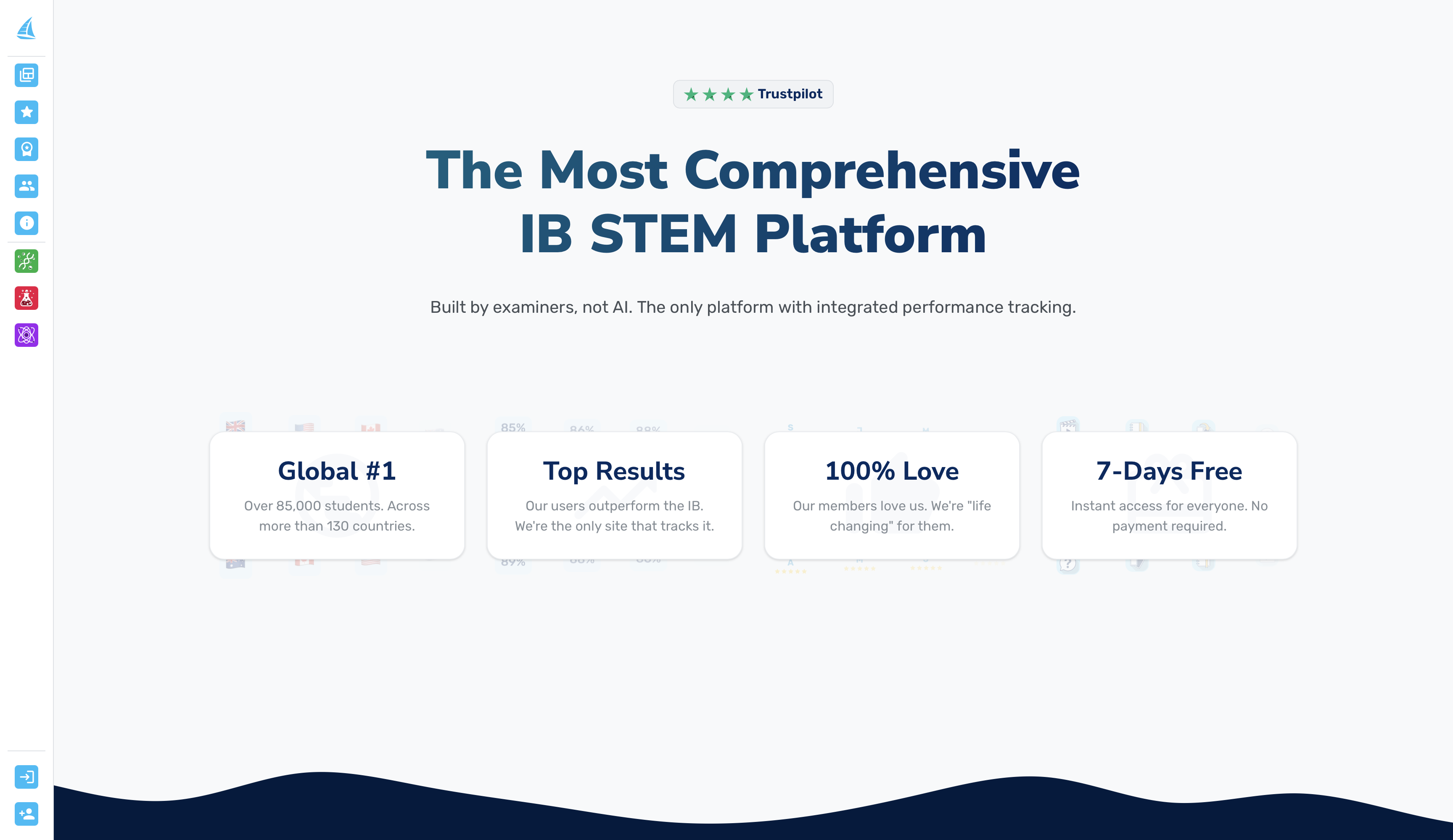
You get exam-style questions, examiner mark schemes, a custom test builder, IA exemplars, topic tests and mock exams for Biology, Chemistry, Physics and IB Maths. Parents can see how it supports a student on our page for IB parents. Students can start from the IB students page, or go straight to the IB Biology mock exams.
FAQ
Are IB or A levels harder?
They are hard in different ways. The IB asks for breadth and constant deadlines across six subjects and the core. A levels ask for depth in three or four subjects, with pressure concentrated around the final exams. The better fit depends on how you work.
Do US universities accept A levels?
Yes, A levels are accepted from international applicants, and colleges read them in the context of your school system. Many also ask for SAT or ACT scores, and credit policies vary by college. Check each admissions page for the current rules.
Do I get college credit for IB exams in the US?
Often, but usually only for Higher Level exams, and the minimum score differs by college. Georgetown, Northeastern and NYU Stern all limit credit to Higher Level, with scores of 5 to 7 required depending on the college. Read each policy before you choose HL subjects.
Can I keep my options open with the IB?
Yes. The IB spreads you across six subject groups, so you do not have to commit to one field early. You can still take sciences and maths at Higher Level to support a STEM degree.
Sources
- DP curriculum, International Baccalaureate
- Diploma programme assessment, International Baccalaureate
- Comparing A levels with the IB examinations, UK Government
- Cambridge International AS and A Levels
- The complete guide to A-level, BTEC and International choices
- IBDP and A Levels: Which pathway best suits your child?
- Understanding Your Academic Record as an International Applicant, USC
- Advanced Credit, Georgetown
- International Baccalaureate transfer credit policy, Northeastern
- Admissions, NYU Bulletins
- IGCSE-aligned math content, Kidocode