
IB Homeschool Science Resources: What to Use and Why
The best IB homeschool science resource is one built around the IB syllabus and the way the IB examines it, not a general science curriculum. For Biology, Chemistry and Physics, that means exam-style questions, examiner mark schemes, clear notes and a way to see where marks are being lost. Tiber Tutor brings all of this together in one place, written by actual IB examiners, so a parent does not need to piece a course together from separate sources.
TL;DR
- General homeschool science kits and lesson plans are rarely written for the IB. IB science needs resources mapped to the IB subject guide.
- Look for four things: syllabus alignment, exam-style practice, mark schemes and progress tracking.
- Tiber Tutor covers IB Biology, Chemistry, Physics and Maths with notes, videos, flashcards, topic tests, mock exams and analytics, all linked to each other.
- Plans start at $9 per month per subject, or $19 per month for All-Access, after a free 7-day trial.
- Diploma students need to be registered through an IB World School or authorised provider for internal assessment.
Table of Contents
- Why most homeschool science resources fall short for the IB
- Which IB stages and science subjects are covered?
- How to check a resource matches the current syllabus
- What a complete IB science toolkit includes
- A weekly routine for a homeschooled IB science student
- Hands-on work, internal assessment and registration
- Why Tiber Tutor gives the best value for IB science
- Our perspective
- FAQ
- Sources
Why most homeschool science resources fall short for the IB
Search for homeschool science and you will find lesson plans, hands-on kits and reading lists. Many are lovely for younger learners. Few are written for the IB.
IB sciences ask for something specific. Students must explain, apply and evaluate, and they must answer in the command-term style that IB papers use. A resource that teaches the science well but never shows what a full-mark answer looks like leaves a gap. Homeschool families feel that gap most, because there is no classroom teacher marking practice papers each week.
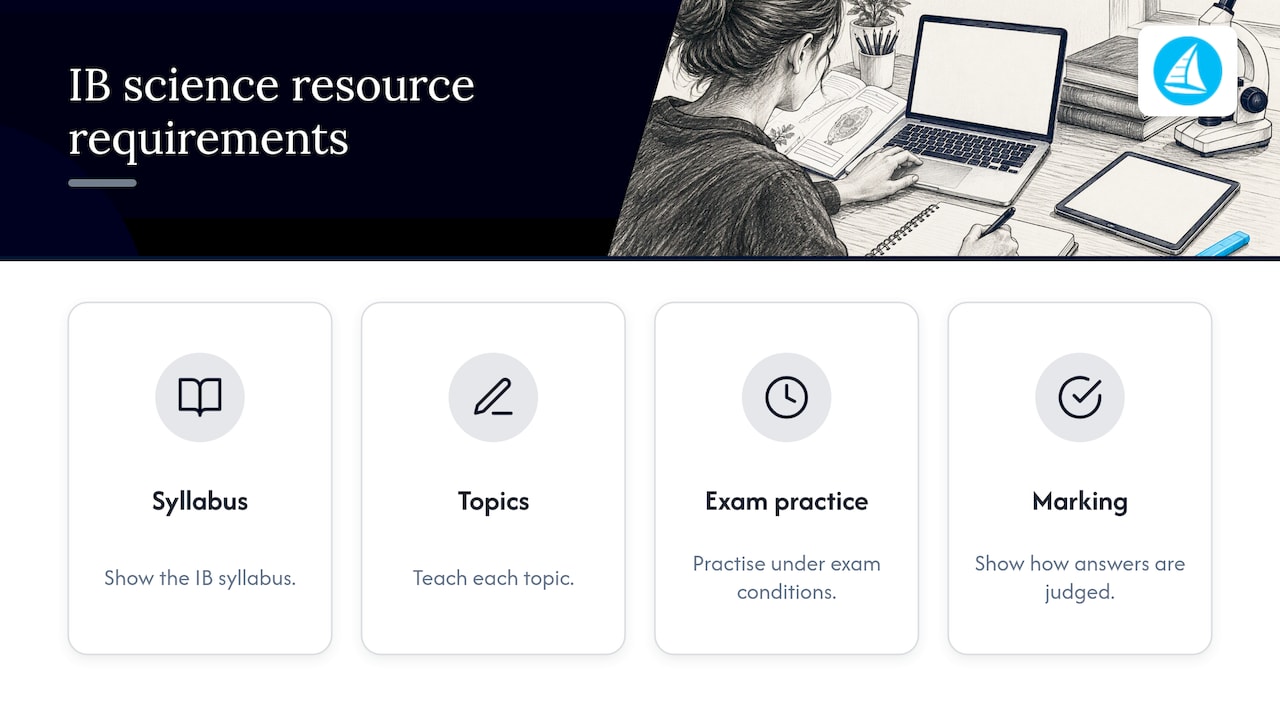
The resource you choose should close that gap. It should show the syllabus, teach each topic, let your student practise under exam conditions and show exactly how answers are judged.
Which IB stages and science subjects are covered?
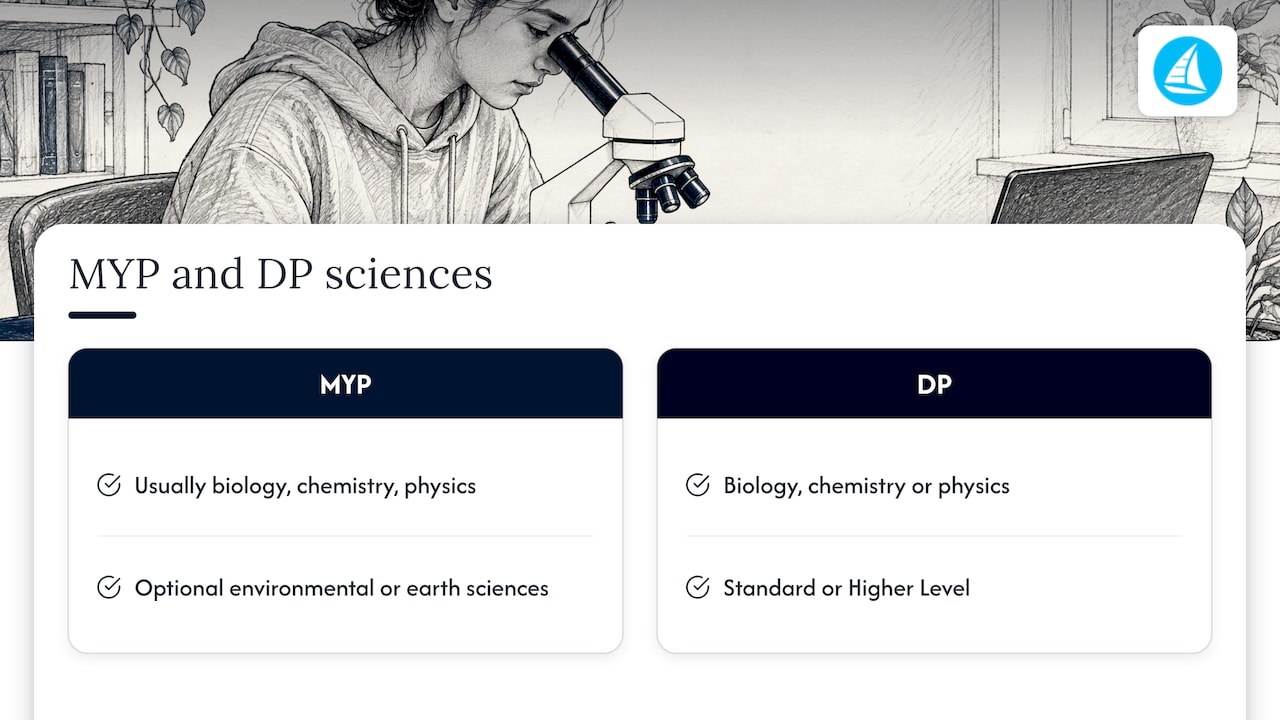
The IB runs sciences across more than one programme. In the Middle Years Programme (MYP), the IB states that science courses usually include biology, chemistry and physics, with other options such as environmental or earth sciences at some schools. In the Diploma Programme (DP), students normally study Biology, Chemistry or Physics at Standard or Higher Level.
Tiber Tutor is built for the Diploma-level sciences and IB Maths: Biology, Chemistry, Physics and Maths. If your student is aiming for top DP scores, this is where it is designed to help. For an overview of how the three sciences differ in content and workload, our guide to IB courses explained: Biology, Chemistry and Physics is a good starting point.
How to check a resource matches the current syllabus
Syllabus alignment is the first test, and a parent can check it without being a scientist.
- Find the subject guide. The IB publishes one for every subject. The IB Biology guide, published in February 2023 for first assessment in 2025, is organised around four themes: Unity and diversity, Form and function, Interaction and interdependence, and Continuity and change.
- Check the edition. Chemistry and Biology both have a current syllabus and a previous one. Make sure notes and questions are written for the version your student will sit.
- Compare the topic list. Every note set, video series and question bank should map to the guide’s topics, so nothing is missed and nothing is padding.
- Look at the authors. Resources written by people who mark IB papers reflect how the IB awards marks.
The IB also uses an official signal for books. It says co-published resources carry an “In cooperation with” logo and go through quality checks against the latest curriculum. It is a useful guide when buying printed textbooks.
On Tiber Tutor, the syllabus is part of the platform. You can follow the IB Biology syllabus topic by topic and monitor which parts your student has covered, and the same structure runs through the notes, questions and tests.
What a complete IB science toolkit includes
A homeschool week is easier when every tool points at the same syllabus. Here is what a full set looks like and where Tiber Tutor provides it.
| Need | What it does for your student | On Tiber Tutor |
|---|---|---|
| Notes | Explain each syllabus point in exam-ready language | IB Biology notes and definitions |
| Videos | Make hard ideas visual | Animated IB Biology videos, organised by topic |
| Flashcards and cram sheets | Build recall and support last-minute revision | Included for the sciences |
| Exam-style questions | Practise how the IB actually asks | Science question bank |
| Topic tests and custom tests | Check one area at a time | Topic-specific tests and a custom test builder |
| Mock exams | Rehearse the full paper | Biology, Chemistry and Maths AI mocks |
| Mark schemes | Show how marks are earned | Examiner mark schemes with student-led answer review |
| Progress tracking | Show strengths and gaps | Syllabus monitoring and advanced analytics |
| IA support | Show what strong investigations look like | IA exemplars |
The value is in how these connect. A student watches a video on ecosystems, reads the notes, answers questions on the topic, marks their own work against the examiner scheme and then sees the result in their analytics. The next session starts from evidence, not guesswork.
A weekly routine for a homeschooled IB science student
A simple pattern works well across the two Diploma years.
- Learn: Start a topic with the video, then read the notes. Keep it to one syllabus topic at a time.
- Recall: Use flashcards for definitions and key terms. Short, frequent sessions are better than one long one.
- Practise: Answer exam-style questions on that topic, written out in full, without looking at the notes.
- Review: Mark the answer against the examiner mark scheme. This is the step that teaches students what the IB wants to see.
- Check: Look at the analytics. If one sub-topic keeps costing marks, return to it before moving on.
- Rehearse: Build to topic tests, then full mock exams under timed conditions as the exams approach.
Parents do not need a science degree to run this. The platform shows what has been covered and where the weak points are, which makes a progress conversation with your student specific and calm. Our guide to homeschooling the IB curriculum walks through planning in more detail.
Hands-on work, internal assessment and registration
Practical work matters in IB sciences. Students carry out an internal assessment, an investigation of their own, which is marked within the course. Tiber Tutor provides IA exemplars so your student can see what strong investigations look like and how they are judged.
One point to plan early: for the full Diploma, internal assessments need supervision and marking by registered IB teachers, so students need to be registered through an IB World School or authorised partner provider. We explain the enrolment route in our IB homeschool roadmap. If you are also weighing up school options for younger children, a guide to choosing an IB primary school covers the practical questions.
Why Tiber Tutor gives the best value for IB science
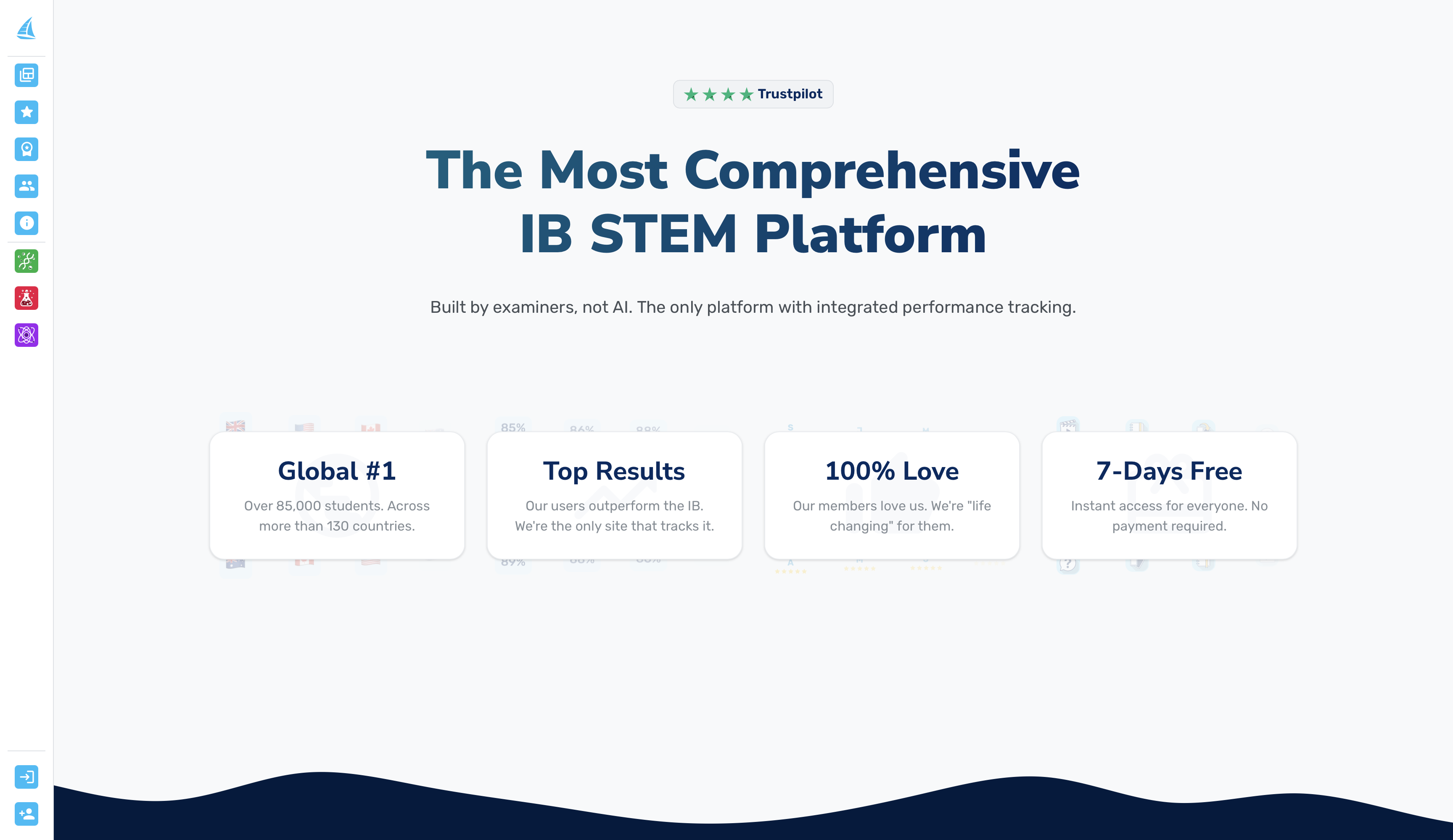
We are an IB STEM platform made by actual IB examiners, and that matters when you are paying for a resource. Examiner-written content is built to reflect the exam, from the wording of questions to the mark schemes. Our content is fully syllabus-aligned and updated for the current exam cycle.
It is also the combination that gives the best value for money. Notes, videos, flashcards, cram sheets, tests, mocks, mark schemes and analytics sit under one membership, and they are linked to each other. Integrated performance tracking with student-led answer review is something we built specifically so that families can see progress, not just hope for it.
Pricing is straightforward:
- Per-Subject Plan: $9 per month
- All-Access Plan: $19 per month
Every membership starts with a free 7-day trial, and longer terms are available: monthly, 6-month, yearly or the full 24-month course. A student taking two or three sciences will find the All-Access Plan covers everything under one subscription.
Ready to see how it works for your student? Start with the pricing page to pick a plan, or look at our resources for IB parents to see how families use the platform at home.
Our perspective
Homeschooling the IB is a real act of care. You are taking on a demanding course, and you want your child to feel prepared and curious, not anxious.
We built Tiber Tutor around one belief: confidence comes from knowing exactly where you stand. When a student can watch a clear animation, practise with questions that feel like the real paper, mark their own answer against an examiner’s scheme and then see the pattern in their analytics, the course stops feeling like a mountain. It becomes a series of steps.
That is why our resources are written by IB examiners and why every part connects to the next. We want the notes, the questions and the progress tracking to work as one calm, thoughtful system for you and your child.
Oliver
FAQ
Can I homeschool IB sciences with free resources alone?
Free lesson plans can support curiosity, especially for younger learners. For the Diploma, students also need syllabus-mapped notes, exam-style questions and mark schemes. Tiber Tutor brings these together, and you can begin with the free 7-day trial.
Which IB science subjects does Tiber Tutor cover?
It covers IB Biology, Chemistry and Physics, plus IB Maths. Each has resources such as notes, videos, flashcards, topic tests and mock exams, with analytics to track progress.
How much does it cost?
The Per-Subject Plan is $9 per month and the All-Access Plan is $19 per month. Memberships can run monthly, for 6 months, yearly or for the full 24-month course, after a free 7-day trial.
Do parents need a science background?
No. Videos and notes explain each topic, and examiner mark schemes show how answers are judged. The analytics make it easy to see what has been covered and where more practice is needed.