IB Biology D4.1 Notes
This page contains our IB Biology notes for D4.1. By reading each one of these notes, you will fully cover the content for IB Biology 'Further natural selection'.
Gene pool
In the HL syllabus, you need to know more detail about natural selection. Here, you are supposed to appreciate that many characteristics are polygenic and thus impact an organism's ability to survive and reproduce. In the context of natural selection, the term used for all these characteristics is gene pool. This is all the genes, and their different alleles, present in an interbreeding population.
Due to natural selection, some alleles may appear more frequently than others. This can be visualized by gene pool distribution, and there are three main patterns you need to be aware of:
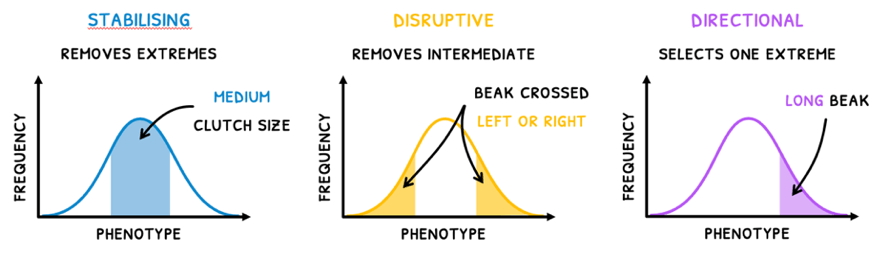
Stabilizing natural selection - this occurs when selection pressures remove the extremes of a phenotype.
For example, the clutch size of eggs are mostly medium in number, as too few eggs decreases survival rate, whereas too many increases predation.
Disruptive natural selection - this occurs when selection pressures remove the intermediate phenotype.
For example, the beak of the red crossbill is either crossed left or right, but never straight as the crossing allows it to extract conifer cones and obtain food.
- Directional natural selection - this occurs when selection pressures select one extreme of a phenotype. For example, the Darwinian finches during El Nino were selected for longer beaks during times of drought.
tibertutor.com
Next Up
You have completed the sub-topic D4.1 notes, covering "Further natural selection" for IB Biology - continue with related resources below or explore the full IB Biology course from the IBO.
Other Sub-topic D4.1 resources