IB Biology A4.1 Further speciation notes
3 chapters
Speciation
The concept of reproductive isolation has been previously introduced. This is the separation of two populations, so they are unable to interbreed and thus undergo differential selection and speciation. There were three types of reproductive isolation introduced: geographic isolation, temporal isolation, and behavioural isolation.
This is important to recap because the type of reproductive isolation influences the type of speciation. There are two main types:
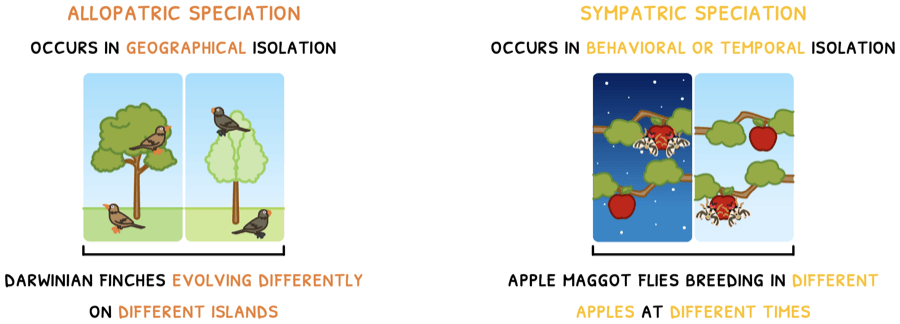
- Allopatric speciation occurs in geographical isolation. An example would be Darwinian finches evolving differently on different Galapagos islands. Since gene flow is blocked, it creates distinct gene pools.
- Sympatric speciation occurs in behavioural or temporal isolation. An example would be apple maggot flies breeding in different apple types at different times, even though they live in the same orchard.
In either case, over time the populations change enough that they can no longer interbreed and adapt to their environment.
tibertutor.com
Next Up
You have completed the sub-topic A4.1 notes, covering "Further speciation" for IB Biology - continue with related resources below or explore the full IB Biology course from the IBO.
Other Sub-topic A4.1 resources